
1. Introduction
The global aviation industry is undergoing profound technological transformation through the integration of artificial intelligence (AI), unmanned aircraft systems (UAS), digital air traffic management (ATM), satellite-based navigation, predictive maintenance, and autonomous aviation operations. These developments enhance efficiency and connectivity while increasing the complexity of aviation safety governance (International Civil Aviation Organization [ICAO], 2019). As aviation systems become increasingly digitalized and interconnected, national aviation regulatory authorities play a critical role in ensuring effective oversight.
This technological shift has transformed aviation oversight from compliance-based supervision to predictive, performance-based, and risk-oriented systems. Modern regulators are required to possess advanced competencies, including cybersecurity, software assurance, AI applications, data analytics, and integrated operational systems. Therefore, aviation safety now depends not only on operator compliance but also on the adaptability and technological literacy of regulatory personnel (Stolzer et al., 2016).
To harmonize global aviation safety standards, ICAO established the Universal Safety Oversight Audit Programme (USOAP), which evaluates member states using eight Critical Elements (CE). Among them, Critical Element 4 (CE-4): Technical Personnel Qualification and Training is strategic because it assesses whether states have sufficient numbers of qualified inspectors, structured initial and recurrent training, competency management frameworks, on-the-job training (OJT), and continuous professional development mechanisms (ICAO, 2019; 2023). CE-4 serves as the human capital foundation of aviation oversight, as the effectiveness of all other CE functions depends on inspector competence.
The significance of CE-4 is amplified by emerging technologies such as remotely piloted aircraft systems (RPAS), urban air mobility, digital towers, AI-assisted operations, and autonomous aviation. Traditional inspector competencies are insufficient for supervising these highly automated, data-driven environments. Modern inspectors must understand cybersecurity vulnerabilities, software assurance processes, aviation data governance, predictive analytics, and machine-learning operational systems (European Union Aviation Safety Agency [EASA], 2022).
In Indonesia, CE-4 implementation reflects the Directorate General of Civil Aviation’s capacity to oversee airlines, airports, air navigation services, maintenance organizations, and emerging technologies. Indonesia’s aviation market is one of the largest in Southeast Asia, supported by archipelagic geography, growing middle-class mobility, and expanding infrastructure. Domestic passenger traffic exceeded 140 million and international traffic surpassed 25 million in 2024 (Ministry of Transportation Indonesia, 2024). This growth creates complex oversight challenges across thousands of islands, diverse operational conditions, and expanding urban airspace.
Despite governance reforms, Indonesia faces challenges in CE-4 implementation. Quantitatively, the number of qualified inspectors is limited relative to the scale of aviation operations. Only a small proportion of inspectors possess advanced certifications or specialized competencies in UAS oversight, cybersecurity, digital ATM, or AI-assisted supervision. Qualitatively, training systems remain largely classroom-based, recurrent training is procedural rather than competency-focused, and digital learning and tracking infrastructures are insufficiently integrated. As the aviation industry transitions to automated, data-centric operations, oversight systems risk becoming reactive rather than anticipatory.
These conditions directly impact Indonesia’s Effective Implementation (EI) scores in USOAP, particularly CE-4 Protocol Questions (PQ) assessing inspector competency, training adequacy, and professional development effectiveness (ICAO, 2023). A paradox emerges: operators adopt advanced technologies to enhance efficiency and competitiveness, yet regulatory competency frameworks remain fragmented, administrative, and insufficiently adaptive. This widening gap threatens the regulator’s ability to supervise emerging technologies effectively.
Further complexity arises from the disparity between global regulatory expectations and domestic realities. International aviation governance increasingly requires predictive safety oversight, competency-based management, and technology-oriented surveillance. Indonesia faces structural limitations, including budget constraints, insufficient specialized inspectors, limited training access, and high attrition to private sectors, resulting in “brain drain” and weakening institutional continuity (Wensveen, 2018).
Three major gaps affect CE-4 implementation: (1) a theoretical gap between ICAO’s competency-based oversight ideal and practical inspector limitations; (2) a regulatory gap in integrating competency management, recurrent training, and digital learning into national oversight frameworks; and (3) an empirical gap where formal compliance documentation does not fully reflect operational readiness of inspectors.
Strengthening CE-4 extends beyond ICAO audit performance—it influences international trust, safety reputation, airline competitiveness, foreign investment confidence, and sustainable growth of Indonesia’s aviation sector (Federal Aviation Administration [FAA], 2022). Therefore, CE-4 must be pursued as a strategic agenda to develop resilient, adaptive, and future-ready aviation governance systems.
This study critically examines Indonesia’s CE-4 implementation, addressing quantitative and qualitative challenges, institutional paradoxes, and theoretical, regulatory, and empirical gaps in aviation oversight effectiveness. The central research question guiding this study is: How can Indonesia strengthen the implementation of ICAO USOAP CE-4 through sustainable competency development, adaptive regulatory frameworks, and technology-oriented oversight systems to address the gaps emerging from rapid aviation technological transformation?
2. Literature Review and Best Practices
2.1 Conceptual Framework of CE-4 in Aviation Oversight
Critical Element 4 (CE-4) of the International Civil Aviation Organization (ICAO) Universal Safety Oversight Audit Programme (USOAP) focuses on Technical Personnel Qualification and Training, emphasizing the competency, sustainability, and professional development of aviation inspectors and regulatory personnel (ICAO, 2019). Within the USOAP framework, CE-4 evaluates whether member states possess adequate systems to ensure that inspectors are appropriately qualified, continuously trained, and capable of conducting effective aviation safety oversight. Specifically, CE-4 assesses the existence of minimum qualification standards, structured initial and recurrent training programs, on-the-job training (OJT) systems, competency management mechanisms, and continuous professional development frameworks.
The conceptual foundation of CE-4 is closely aligned with human capital theory, which argues that organizational performance is fundamentally determined by the quality of human resources, including education, technical skills, experience accumulation, and continuous learning (Becker, 1993). In the aviation oversight context, inspector competency represents a strategic institutional asset because the effectiveness of surveillance, certification, licensing, and safety management oversight depends directly on the technical capability of regulatory personnel. Consequently, the sustainability of aviation safety governance increasingly relies on the ability of regulators to develop adaptive and technologically literate human resources.
The transformation of global aviation technologies has further expanded the competency requirements of aviation inspectors. The integration of artificial intelligence (AI), unmanned aircraft systems (UAS), digital air traffic management (ATM), predictive maintenance systems, and autonomous aviation operations has shifted aviation oversight from traditional compliance-based supervision toward predictive and risk-based oversight systems. According to Stolzer et al. (2016), modern aviation oversight requires inspectors to move beyond procedural compliance and develop analytical capabilities for interpreting operational data, identifying emerging safety risks, and adapting oversight methodologies dynamically. This approach is consistent with ICAO’s transition toward State Safety Programme (SSP) implementation and data-driven safety management systems.
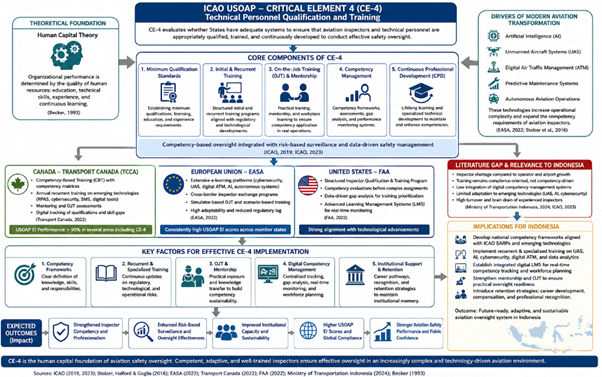
Fig 1. Conceptual Framework
Within this context, competency-based oversight frameworks are increasingly integrated with risk-based surveillance methodologies. Aviation inspectors are now expected to understand cybersecurity risks, software assurance systems, digital operational infrastructures, aviation data governance, and AI-assisted operational systems (European Union Aviation Safety Agency [EASA], 2022). Therefore, CE-4 no longer merely evaluates administrative training compliance but increasingly measures the institutional capability of states to maintain adaptive and future-oriented regulatory competency systems.
2.2 International Best Practices
2.2.1 Canada – Transport Canada Civil Aviation (TCCA)
Transport Canada Civil Aviation is widely recognized for implementing an advanced Competency-Based Training (CBT) system for aviation inspectors. The system integrates structured competency matrices defining inspector knowledge, technical skills, behavioural indicators, and operational capabilities across multiple oversight domains, including airworthiness, flight operations, airports, and air navigation services.
Transport Canada also applies annual recurrent training programs aligned with emerging aviation technologies and evolving international regulations. Training areas include remotely piloted aircraft systems (RPAS), digital oversight tools, aviation cybersecurity, and safety management systems (SMS). In addition, inspectors undergo structured mentoring and OJT assessments to ensure practical competency application before independently conducting oversight activities.
A significant strength of the Canadian system lies in its integration of digital competency tracking tools, enabling regulators to monitor inspector qualifications, training completion, competency gaps, and recurrent training requirements in real time. According to Transport Canada (2022), these integrated competency management systems contribute significantly to Canada’s consistently high USOAP Effective Implementation (EI) performance, which exceeds 90% in several oversight areas, including CE-4.
2.2.2 European Union – European Union Aviation Safety Agency (EASA)
European Union Aviation Safety Agency emphasizes continuous professional development through highly adaptive inspector training systems designed to address rapidly evolving aviation technologies. EASA has developed extensive e-learning platforms covering cybersecurity oversight, unmanned aircraft systems, digital ATM, AI-assisted operational systems, and autonomous aviation technologies (EASA, 2022).
One notable best practice implemented within the European Union is the cross-border inspector exchange program, allowing aviation inspectors from different member states to share operational experiences, harmonize oversight practices, and strengthen regional competency consistency. EASA also utilizes simulator-based OJT and scenario-based oversight training to improve inspector readiness in complex operational environments.
These initiatives have significantly improved inspector adaptability and reduced regulatory lag relative to technological developments within the European aviation sector. As a result, many European states consistently achieve high USOAP EI scores, particularly in oversight domains associated with technical competency and training systems.
2.2.3 United States – Federal Aviation Administration (FAA)
Federal Aviation Administration applies a structured Inspector Qualification and Training Program emphasizing standardization, competency assessment, and data-driven training management. The FAA categorizes inspectors into specialized qualification domains such as airworthiness, flight operations, and air navigation services (FAA, 2022).
The FAA system requires inspectors to complete competency evaluations before being assigned to high-risk or technically complex oversight activities. Training priorities are determined through data-driven competency gap analyses, ensuring alignment between organizational oversight needs and inspector capabilities. Furthermore, the FAA employs advanced Learning Management Systems (LMS) to monitor training completion, qualification validity, and inspector competency status in real time.
This integrated training approach enables the FAA inspector workforce to maintain high levels of alignment with technological developments in both commercial aviation and unmanned aircraft operations. The FAA model demonstrates how digital competency management systems can significantly enhance oversight effectiveness and institutional adaptability.
2.3 Key Factors for Effective CE-4 Implementation
The literature and international best practices reviewed above indicate five key factors influencing successful CE-4 implementation.
First, competency frameworks are essential for defining inspector knowledge, technical skills, and operational responsibilities. Clearly structured competency matrices ensure consistency in qualification standards and oversight capability.
Second, recurrent and specialized training is necessary to maintain inspector competency amid rapid technological transformation. Continuous updates on emerging technologies, regulatory developments, and operational risks are critical for sustaining oversight effectiveness.
Third, on-the-job training and mentorship systems provide inspectors with practical operational exposure and strengthen experiential learning processes. Mentorship programs also facilitate institutional knowledge transfer and reduce competency gaps among junior inspectors.
Fourth, digital competency management systems enable centralized monitoring of inspector qualifications, recurrent training status, competency gaps, and workforce planning. Such systems improve transparency, efficiency, and strategic human resource management.
Fifth, institutional support and retention strategies are required to maintain organizational continuity and reduce the loss of experienced personnel. Countries implementing structured career pathways and professional development incentives generally demonstrate stronger oversight sustainability (ICAO, 2023).
2.4 Literature Gap and Relevance to Indonesia
Although CE-4 principles are well established internationally, significant implementation gaps remain evident in many developing countries, including Indonesia. According to the Ministry of Transportation of the Republic of Indonesia (2024), the rapid expansion of aviation operators, airports, and air traffic has not been fully matched by proportional growth in qualified aviation inspectors.
Existing literature also highlights several structural weaknesses within developing-state oversight systems, including training approaches that remain compliance-oriented rather than competency-driven, low integration of digital competency management systems, limited adaptation to emerging technologies, and high turnover among experienced inspectors. These challenges reduce institutional adaptability and weaken long-term oversight sustainability.
Comparatively, best practices from Canada, the European Union, and the United States demonstrate that competency-based, digitally integrated, and mentorship-supported systems substantially improve oversight effectiveness and inspector adaptability (FAA, 2022; ICAO, 2023). However, empirical studies specifically examining Indonesia’s readiness to strengthen CE-4 implementation within the context of emerging aviation technologies remain limited. This gap underscores the importance of further research addressing the institutional, regulatory, and competency challenges affecting Indonesia’s aviation oversight system.
2.5 Implications for Indonesia
Lessons derived from international best practices suggest several strategic implications for Indonesia. First, Indonesia should establish a national competency framework defining inspector qualifications, technical competencies, and specialized oversight skill sets across operational domains. Second, recurrent and specialized training programs should be aligned with emerging aviation technologies such as UAS, AI-assisted systems, cybersecurity oversight, and digital ATM.
Third, the development of integrated digital learning management systems is necessary to support real-time competency tracking and workforce planning. Fourth, mentorship and structured OJT programs should be strengthened to improve practical oversight readiness and institutional knowledge transfer. Finally, retention strategies addressing compensation, career development, and professional recognition are required to reduce brain drain among skilled inspectors.
Collectively, these measures aim to bridge the theoretical, regulatory, and empirical gaps affecting CE-4 implementation in Indonesia while strengthening the long-term sustainability of aviation safety oversight within an increasingly complex global aviation environment.
3. Discussion
3.1 Overview
The implementation of Critical Element 4 (CE-4) within the International Civil Aviation Organization (ICAO) Universal Safety Oversight Audit Programme (USOAP) represents one of the most strategic dimensions of aviation safety governance in Indonesia. CE-4 focuses on Technical Personnel Qualification and Training, evaluating whether aviation inspectors and regulatory personnel possess sufficient qualifications, competency sustainability, recurrent training, and institutional support necessary to conduct effective aviation safety oversight activities (ICAO, 2019). In the contemporary aviation environment characterized by digital transformation, automation, artificial intelligence (AI), and integrated aviation ecosystems, the effectiveness of aviation oversight increasingly depends on the capability and adaptability of regulatory personnel rather than solely on procedural compliance systems.
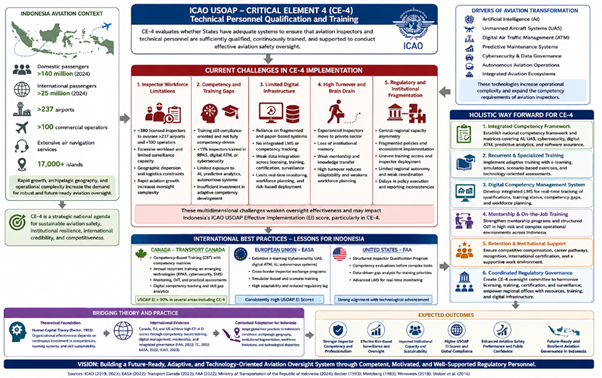
Fig 2. Strengthening Framework
Indonesia’s aviation industry has experienced rapid expansion over the last decade. According to the Ministry of Transportation of the Republic of Indonesia (2024), domestic passenger traffic exceeded 140 million passengers in 2024, while international traffic surpassed 25 million passengers. Indonesia currently operates more than 237 airports, over 100 commercial operators, and extensive air navigation services distributed across more than 17,000 islands. Such geographical and operational complexity significantly increases the demand for robust aviation oversight systems capable of supervising diverse operational environments, ranging from remote airports and mountainous regions to highly congested urban airspace and technologically advanced aviation operations.
Within this context, strengthening CE-4 should no longer be perceived merely as an administrative requirement to improve ICAO audit performance. Instead, it must be viewed as a strategic national agenda for ensuring sustainable aviation safety governance, institutional resilience, international credibility, and long-term competitiveness within the global aviation ecosystem. However, despite substantial progress in aviation governance reforms, Indonesia continues to face multidimensional challenges affecting the implementation of CE-4, including inspector shortages, competency gaps, digital infrastructure limitations, organizational fragmentation, and institutional retention problems.
3.2 Current Challenges in CE-4 Implementation
3.2.1 Inspector Workforce Limitations
One of the most fundamental challenges in CE-4 implementation is the imbalance between the number of aviation inspectors and the scale of Indonesia’s aviation operations. The Directorate General of Civil Aviation (DGCA) is responsible for supervising airlines, airports, maintenance organizations, aviation training institutions, and air navigation service providers distributed across a vast archipelagic territory. According to the Ministry of Transportation Indonesia (2024), Indonesia currently employs approximately 380 licensed aviation inspectors responsible for overseeing more than 237 airports and over 100 commercial aviation operators.
This imbalance creates excessive workload concentration and limits the ability of inspectors to conduct comprehensive risk-based surveillance activities. ICAO (2023) emphasizes that adequate staffing levels are critical for maintaining oversight continuity and ensuring timely surveillance implementation. In practice, inspector shortages in Indonesia often force oversight activities to focus on administrative compliance rather than competency-based and predictive oversight systems. Operational challenges become even more significant in remote regions where geographical constraints and logistical limitations hinder regular inspection activities.
Furthermore, rapid aviation growth continuously increases oversight complexity. Indonesia’s aviation system now includes expanding low-cost carriers, growing unmanned aircraft system (UAS) operations, increasing international connectivity, and modernization of airport infrastructure. Without proportional growth in inspector capacity and specialization, oversight effectiveness risks becoming increasingly reactive rather than anticipatory.
3.2.2 Competency and Training Gaps
Another major challenge concerns the sustainability and quality of inspector competency development systems. Although DGCA has implemented initial and recurrent training programs, many of these programs remain heavily compliance-oriented and insufficiently adaptive to technological transformation. Existing training approaches still rely predominantly on conventional classroom methodologies and administrative certification systems, with limited integration of advanced technological domains such as AI-assisted operations, aviation cybersecurity, digital ATM, predictive analytics, and autonomous aviation systems.
According to the European Union Aviation Safety Agency (EASA, 2022), only a limited proportion of inspectors in developing countries possess advanced competencies in emerging aviation technologies. In Indonesia, less than 15% of inspectors have received specialized training related to RPAS oversight, digital ATM systems, or cybersecurity monitoring. Consequently, a substantial competency gap exists between rapidly modernizing aviation operators and the regulatory personnel responsible for supervising them.
From the perspective of human capital theory, such conditions indicate insufficient institutional investment in adaptive competency development systems. Becker (1993) argues that organizational effectiveness depends fundamentally on continuous investment in technical expertise, learning systems, and skill sustainability. Therefore, inadequate competency development directly weakens institutional capability and oversight resilience.
3.2.3 Limited Digital Infrastructure
Digital transformation within Indonesia’s aviation oversight institutions also remains relatively limited compared to global best practices. Advanced regulators such as the Federal Aviation Administration and Transport Canada Civil Aviation utilize integrated Learning Management Systems (LMS), digital competency matrices, and predictive workforce analytics to monitor inspector qualifications and training effectiveness in real time (FAA, 2022; Transport Canada, 2022). In contrast, Indonesia’s oversight system still relies significantly on fragmented administrative systems and paper-based documentation.
The absence of integrated digital competency management systems limits the ability of DGCA to identify competency gaps, plan recurrent training effectively, and align inspector qualifications with operational risks. Fragmented databases also weaken institutional coordination between licensing, training, certification, and surveillance units. In an increasingly data-driven aviation environment, the inability to integrate competency management systems with operational oversight data creates substantial institutional vulnerabilities.
ICAO (2023) emphasizes that modern oversight systems should integrate digital competency monitoring, evidence-based workforce planning, and risk-based surveillance approaches. Without such digital integration, oversight systems risk becoming administratively burdensome and operationally inefficient.
3.2.4 High Turnover and Brain Drain
Retention challenges also significantly affect the sustainability of CE-4 implementation in Indonesia. Experienced inspectors frequently migrate to private aviation industries due to more competitive salaries, stronger career opportunities, and more attractive professional environments. According to Wensveen (2018), this “brain drain” phenomenon is common among developing-state aviation regulators and frequently undermines institutional continuity.
The departure of experienced personnel reduces organizational memory, weakens mentorship systems, and limits practical knowledge transfer to junior inspectors. Consequently, oversight institutions become increasingly dependent on a small number of senior personnel while competency gaps among younger inspectors remain unresolved. In the long term, high turnover rates reduce institutional adaptability and weaken strategic workforce planning.
3.2.5 Regulatory and Institutional Fragmentation
In addition to technical and competency limitations, Indonesia also faces substantial organizational and governance challenges related to coordination between central and regional oversight structures. Although ICAO Standards and Recommended Practices (SARPs) have been formally adopted, implementation often remains fragmented across departments and operational regions.
Strategic policymaking, licensing authority, and competency standardization remain highly centralized within DGCA headquarters, while operational surveillance responsibilities are distributed among regional offices with varying levels of institutional capacity, technical infrastructure, and budget support. This asymmetry creates disparities in oversight implementation, inspector deployment, and recurrent training participation across regions.
The challenge becomes increasingly significant considering Indonesia’s geographical complexity. Remote airports and regional operators frequently experience limited inspection frequency due to insufficient regional inspector capacity and logistical difficulties. Fragmented communication between central and regional institutions often results in inconsistent reporting systems, delays in policy implementation, and differing interpretations of technical regulations.
Furthermore, advanced competencies related to AI systems, digital ATM, UAS oversight, and cybersecurity are often concentrated at the central level, while regional offices responsible for geographically dispersed operational areas frequently lack inspectors with equivalent expertise. This disparity creates operational dependency on central personnel and reduces regional responsiveness toward emerging aviation technologies.
From an organizational theory perspective, this condition reflects a coordination gap between centralized governance and decentralized operational implementation. Mintzberg (1983) argues that highly centralized bureaucratic systems often struggle to adapt effectively to geographically dispersed and operationally complex environments. In Indonesia’s aviation oversight context, fragmented governance structures weaken policy harmonization, institutional responsiveness, and accountability mechanisms.
3.3 Holistic Conceptualization for a Structured Way Forward
Addressing the multidimensional challenges affecting CE-4 implementation requires a holistic and integrated reform approach combining competency development, organizational restructuring, technological modernization, and institutional sustainability.
3.3.1 Integrated Competency Framework
Indonesia should establish a national competency framework defining technical qualifications, operational competencies, and digital literacy requirements for each inspector category. Competency matrices should include AI systems oversight, UAS operations, cybersecurity, predictive analytics, and software assurance systems. Such frameworks would strengthen alignment between inspector capability and operational complexity while supporting competency-based oversight systems.
3.3.2 Recurrent and Specialized Training
Training systems should evolve from procedural compliance approaches toward adaptive and competency-driven learning ecosystems. Recurrent training programs should incorporate e-learning platforms, simulator-based exercises, scenario-based oversight simulations, and technology-oriented operational assessments. Training curricula must be updated continuously to align with global aviation technological developments (EASA, 2022; FAA, 2022).
3.3.3 Digital Competency Management System
The development of centralized digital competency management systems is essential for improving workforce planning and oversight effectiveness. Integrated LMS platforms would allow DGCA to monitor inspector qualifications, recurrent training status, competency gaps, and workforce deployment requirements in real time. Such systems would also support predictive oversight models and evidence-based regulatory decision-making.
3.3.4 Mentorship and On-the-Job Training
Structured mentorship systems are critical for sustaining institutional knowledge transfer and strengthening practical oversight readiness. Senior inspectors should guide junior personnel through operational mentoring and structured on-the-job training (OJT) involving high-risk operational environments, remote airport operations, and advanced technological systems.
3.3.5 Retention and Institutional Support
Retention strategies including competitive compensation, professional recognition systems, international certification opportunities, and structured career pathways are essential for reducing inspector turnover. Strong retention mechanisms help preserve institutional memory and improve long-term oversight sustainability.
3.3.6 Coordinated Regulatory Governance
Indonesia should establish integrated governance mechanisms connecting licensing, certification, training, and surveillance functions under a centralized CE-4 coordination framework. A dedicated CE-4 oversight committee could monitor competency standards, evaluate training effectiveness, and harmonize oversight implementation across central and regional institutions.
Equally important, regional offices should receive greater institutional empowerment through expanded access to specialized training, digital infrastructure, and operational resources. Such decentralization of competency development would reduce dependency on central institutions and improve regional oversight responsiveness.
3.4 Bridging Theory and Practice
The implementation of CE-4 in Indonesia ultimately requires bridging theoretical, regulatory, and empirical gaps. Human capital theory emphasizes that organizational effectiveness depends fundamentally on continuous competency development and adaptive learning systems (Becker, 1993). However, empirical realities in Indonesia demonstrate substantial disparities between formal regulatory compliance and actual operational readiness.
International best practices from Canada, the European Union, and the United States demonstrate that high CE-4 Effective Implementation scores are strongly associated with competency-based training systems, digital workforce management, mentorship structures, and integrated governance mechanisms (FAA, 2022; Transport Canada, 2022; EASA, 2022). Adapting these practices within Indonesia requires contextualization to local operational realities, including archipelagic geography, institutional fragmentation, workforce limitations, and technological disparities.
Therefore, CE-4 reform in Indonesia should not merely focus on fulfilling ICAO audit requirements but should instead be positioned as a strategic national transformation agenda aimed at building resilient, adaptive, technology-oriented, and future-ready aviation governance systems. The sustainability of Indonesia’s aviation safety oversight capability in the era of autonomous aviation and digital airspace will ultimately depend on the institutional capacity to develop highly competent, continuously adaptive, and technologically literate regulatory personnel capable of responding effectively to rapid industrial transformation.
Closing
The implementation of ICAO USOAP Critical Element 4 (CE-4) represents a strategic foundation for strengthening Indonesia’s aviation safety oversight system in the era of rapid technological transformation. As aviation operations increasingly integrate artificial intelligence, digital air traffic management, unmanned aircraft systems, and autonomous technologies, the effectiveness of safety oversight can no longer rely solely on procedural compliance mechanisms. Instead, it fundamentally depends on the competency, adaptability, and sustainability of aviation regulatory personnel.
This study demonstrates that Indonesia continues to face multidimensional challenges related to inspector shortages, competency gaps, fragmented governance structures, limited digital infrastructure, and institutional retention issues. Furthermore, disparities between central and regional oversight capacities create additional complexity in ensuring consistent implementation of aviation safety policies across the archipelagic operational environment. These conditions collectively reveal significant theoretical, regulatory, and empirical gaps affecting CE-4 implementation.
Nevertheless, international best practices from Canada, the European Union, and the United States indicate that integrated competency frameworks, digital competency management systems, recurrent specialized training, mentorship mechanisms, and coordinated governance structures can substantially improve oversight effectiveness and institutional resilience. Therefore, strengthening CE-4 in Indonesia should be positioned not merely as an administrative obligation under ICAO compliance mechanisms, but as a long-term national strategy for developing adaptive, technology-oriented, and future-ready aviation governance systems capable of sustaining global aviation safety standards and international competitiveness.
References
Becker, G. S. (1993). Human capital: A theoretical and empirical analysis with special reference to education (3rd ed.). The University of Chicago Press.
European Union Aviation Safety Agency. (2022). EASA annual safety review 2022. European Union Aviation Safety Agency.
Federal Aviation Administration. (2022). FAA aviation safety inspector workforce and training framework report. U.S. Department of Transportation.
International Civil Aviation Organization. (2019). Safety oversight manual (Doc 9734, Part A). ICAO.
International Civil Aviation Organization. (2023). Universal Safety Oversight Audit Programme Continuous Monitoring Approach (USOAP CMA): Results and analysis. ICAO.
Ministry of Transportation of the Republic of Indonesia. (2024). Indonesia air transportation statistics 2024. Directorate General of Civil Aviation.
Mintzberg, H. (1983). Structure in fives: Designing effective organizations. Prentice Hall.
Stolzer, A. J., Halford, C. D., & Goglia, J. J. (2016). Safety management systems in aviation (2nd ed.). Routledge.
Transport Canada Civil Aviation. (2022). Civil aviation training and competency management annual report. Government of Canada.
Wensveen, J. G. (2018). Air transportation: A management perspective (9th ed.). Routledge.