

Artificial intelligence (AI) is no longer just a tool in the classroom. It has become a partner in the process of thinking, writing, and evaluating—and in a deeper sense, a partner that forces us to question what it means to be a thinking human being. When a student asks a machine to “write my essay,” or a professor uses an algorithm to create a rubric, we are not merely witnessing a technological change, but a shift in the logic of knowledge and consciousness.
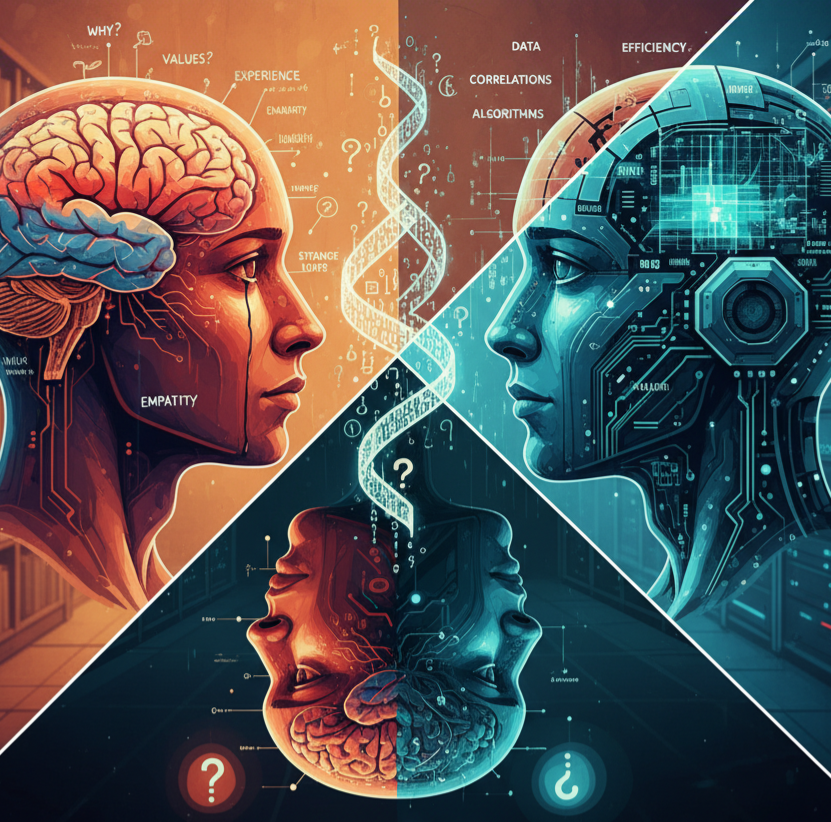
Many people present the narrative that AI will replace humans. This narrative is too simplistic—even misleading. AI is not a freely thinking being; it is a reflection of the patterns we teach it. It is capable of imitating logical sequences, imitating essay styles, and imitating problem solving—but it does not “experience.” This is where the fundamental tension lies: between the human mind, which inhabits a space of experience, values, and anxiety—and the machine mind, which inhabits a space of data, correlations, and algorithms.
The concept proposed by Douglas R. Hofstadter as a strange loop is very relevant to understanding this phenomenon. He explains that in a highly complex system, the starting point and the end point are no longer clear. The human mind creates AI, AI in turn influences the human mind, and we end up spinning in a circle of reflection where the creator and the created reflect each other. (Wikipedia)
In education, we are now at a crossroads: not simply between humans and machines, but between two forms of consciousness—humans who are aware of themselves and machines that merely reflect us. Meaningful education will not be measured by how many answers AI can generate, but by how deeply humans are still able to ask, “Why did I answer that way?” “What values do I hold?” and “How do I impact others?”
Possibilities and Dangers in a New Space
UNESCO publications on AI and education show that while AI offers great potential—personalized learning, expanded access, and administrative efficiency—it also carries serious risks: widening access gaps, data misuse, and simplified learning assessments. (UNESCO)
Other systematic research confirms that integrating AI into the classroom requires specific literacy—not just about how to use the tools, but how to think with and about AI. One study states that the key to learning in the AI era is not just “prompt engineering” but the development of critical thinking and “fluency in technology” as part of the curriculum. (SpringerOpen)
However, the other side of the coin should not be ignored. A critical analysis notes that AI in education has a less discussed “dark side”—excessive dependence, superficial learning, and uncalculated cultural influences. (PMC)
Amidst all these promises, education must answer two important questions: do we still think as meaningful human beings, and do our institutions facilitate these conditions or merely pursue efficiency?
Human Mind vs. Machine Mind: An Unequal Encounter
Machine minds operate differently: they collect data, detect patterns, and predict the next step. However, human minds operate in a different space: experience, doubt, intuition, and responsibility. In education, when machine minds take over routine tasks, we must reinforce the unique aspects that only humans possess.
If college assignments are only measured by results that can be “engineered” by AI, then we hone technical skills without exploring depth. If assessment depends solely on algorithms, then values that are difficult to quantify—empathy, cooperation, civility—are easily marginalized.
Recent research shows that students recognize both the potential and risks of AI: they appreciate AI for its learning support but worry about losing their independent thinking skills and academic integrity. (arXiv) This shows that the problem is not only technological but also moral and educational identity.
Finding Common Ground: Education as a Human–Machine Dialogue
I believe that we must build a new relationship: not humans against machines, not machines replacing humans, but humans and machines thinking together. In this relationship, humans remain conscious and critical subjects, while machines become partners that expand our reach, not eliminate human conditions.
- Practically speaking:Higher education institutions must incorporate AI literacy and technology ethics into their curricula—not as an option, but as a fundamental part of education in this era.
- Educators must adopt the role of “questioner” rather than simply “answerer.” Machines can provide quick answers, but teachers can provoke questions that demand meaning.
- Assessment design must be changed: assignments should reflect the thinking process, character development, and collaboration, not just the final product that can be produced by algorithms.
- Access to technology must be accompanied by attention to equity: campuses in rural areas and private universities should not be overlooked. The gap in access to AI could widen the education gap.
- AI usage policies must be clear: how student data is used, how transparent its use is, and how humans retain ultimate control as guardians of meaning.
Education That Doesn’t Surrender to Machines
When I imagine the future of education, I don’t see silent classrooms where people just stare at screens. I imagine spaces where people take breaks to reflect, discuss, make mistakes, correct them, and then think again. Machines can help break down data, but they cannot replace the human anxiety that makes us grow.
The human mind may now have its own digital shadow, but only humans can feel shame when they are wrong, and only humans are responsible when decisions have consequences. Even when AI writes essays, humans still have to ask: who gives meaning, and who assigns value?
Thus, the future of education is not determined by who adapts to technology the fastest, but who is brave enough to ensure that the thinking process remains human. In this era, machine intelligence is not our enemy—but if we are not careful, it can become an empty mirror that reflects us without depth.
Therefore, when the human mind confronts its own reflection, what must be preserved is not the triumph of technology, but the integrity of human thought. Meaningful education is that which preserves the ability to question, doubt, and give meaning—not merely to answer.

