
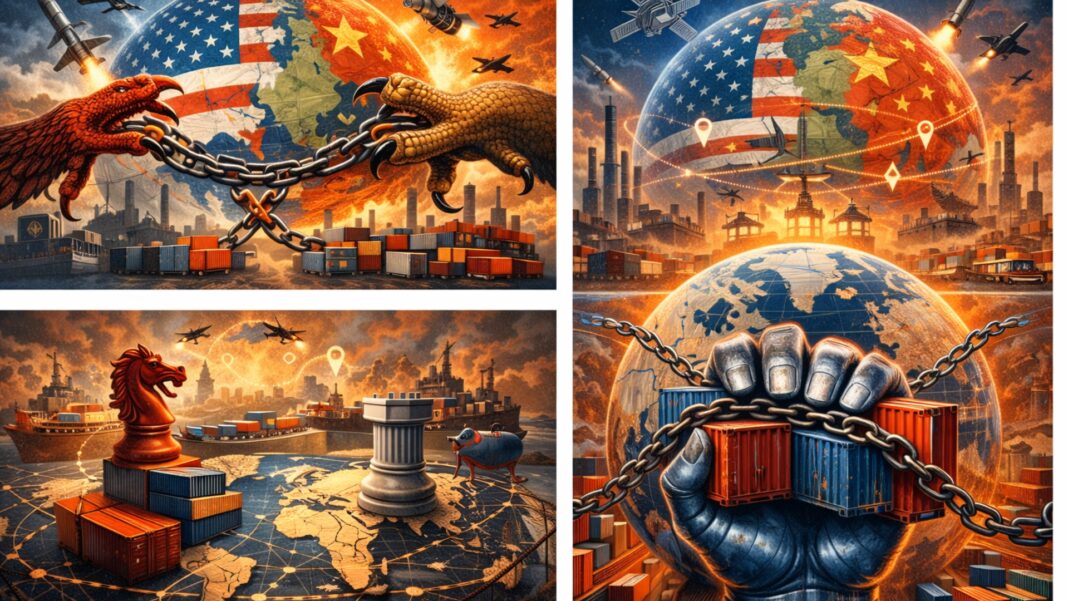

When Chinese President Xi Jinping announced the Belt and Road Initiative (BRI) in 2013, the global public responded with awe. The initiative was presented as the most ambitious and integrative infrastructure project of the 21st century, if not in human history. First articulated during Xi’s state visit to Nazarbayev University in Kazakhstan, the BRI deliberately evoked the legacy of the ancient Silk Road: a vast trading network that once connected China with Eurasia and beyond.
Historically, China expanded its influence not only through diplomacy and trade missions, but also by embedding itself in commercial networks stretching from Central Asia to the western coast of Africa. Chinese merchants exported tea, silk, and porcelain, while importing spices, gemstones, carpets, and fruits. By reviving the Silk Road narrative, Beijing seeks to reinsert this historical memory into a contemporary political-economic framework suited to the realities of the 21st century.
In today’s world, global trade is no longer merely about the cross-border exchange of goods and services. It has evolved into a complex system of supply chains that simultaneously generate economic gains and project political influence. Under conditions of global disruption, the central strategic question is no longer just efficiency, but how goods and services can be distributed while simultaneously shaping geopolitical leverage along supply routes.
China’s rise as a major force in global politics, economics, and trade must be understood within this transformation. The revival of the Silk Road is not symbolic nostalgia; it is a strategic response to a world in which control over logistics, infrastructure, and production networks increasingly determines global power.
BRI and the Architecture of Influence
Xi Jinping reaffirmed the vision of an “economic belt” along the Silk Road during his visit to Indonesia in October 2013. The Maritime Silk Road of the 21st Century signaled China’s determination to integrate Southeast Asia into a broader Eurasian economic architecture, linking East Asia with Europe through massive infrastructure projects.
To date, 151 countries and 32 international organizations have signed cooperation agreements under the BRI framework. According to official statements from Xinhua and China Daily, the initiative has generated over US$1 trillion in investment, created nearly 500,000 jobs, and lifted approximately 40 million people out of poverty along Silk Road corridors.
At the same time, Beijing frames the Indo-Pacific discourse as a challenge to U.S. hegemony, albeit through euphemistic language such as “Asia-Pacific and A Community of Shared Future.” Implicitly, this reflects China’s desire to preserve and expand its influence across a dynamic and strategically vital region.
Unilaterally, the BRI functions as a strategic instrument that positions China as the principal architect of a modern Silk Road, expanding what may be described as a functional zone of sovereignty in contemporary geopolitical terms. The BRI is not designed to overthrow U.S. global dominance in the short term. Rather, its cumulative and structural impact has the potential to erode American hegemony and that of its allied satellites, particularly in economic influence, alliance networks, and strategic access to key regions.
Large-scale infrastructure projects tend to bind recipient countries through contracts, market access, and fiscal obligations. Such economic dependence strengthens China’s non-military leverage, influencing both economic policymaking and diplomatic orientation in partner states. This is how structural power is constructed, quietly, persistently, and without territorial conquest.
The United States, by contrast, has long relied on maritime supremacy and a global military-alliance network. China’s approach differs fundamentally: it builds economic and logistical supply chain networks—ports, railways, airports, digital infrastructure, that reduce reliance on Western-backed systems. While these networks do not replace Western security guarantees, they divide hegemonic influence: China dominates economically through supply chains, while U.S. military power remains decisive. The result is a form of contested multipolarity.
Quasi-Sovereignty and the Logic of Dependence
BRI represents a form of quasi-sovereign expansion. It does not create formal sovereignty, but functional sovereignty operating through infrastructure, advanced technology, logistics, financing, and private security. China does not govern territory; it governs rules, flows, and dependencies. This is a new form of sovereignty suited to an era of global disruption. It is not classical colonialism, but rather an expansion of state capacity that generates effects similar to limited sovereignty through economic binding.
The political philosopher Noam Chomsky has argued that global power shifts when a state can control trade routes, act as a source of global financing, and construct geopolitical infrastructure. BRI satisfies all three criteria, making it a structural challenge to U.S. hegemony rather than a rhetorical one.
The U.S.–China trade war illustrates how supply chains have become weapons. Tariff retaliation, reaching nearly US$450 billion in bilateral trade, reflects a deeper strategic rivalry initiated during the Trump administration. While trade imbalances triggered the conflict, its implications extend far beyond tariffs. Trade wars disrupt supply chains, fragment markets, raise consumer costs, and increase financial volatility. A vivid example was Beijing’s cancellation of Boeing aircraft purchases in response to U.S. tariffs, triggering cascading disruptions across thousands of suppliers. Similarly, Apple’s partial relocation of production to India underscores how firms recalibrate supply chains to hedge geopolitical risk, even while remaining deeply embedded in China. These developments confirm Chomsky’s thesis: global power today is shaped not by normative legitimacy alone, but by the ability to construct and control decisive supply chain networks.
In the contemporary world, sovereignty no longer ends at national borders. It is embedded in logistics corridors, production networks, and financial flows. The Belt and Road Initiative demonstrated how supply chains have become zones of economic sovereignty, spaces where influence is exercised without occupation and power is accumulated without formal rule.
For states that fail to grasp this transformation, vulnerability is inevitable. For those who understand it, supply chains are no longer technical matters of efficiency, but strategic instruments that define their position in the global order.

