
INTRODUCTION
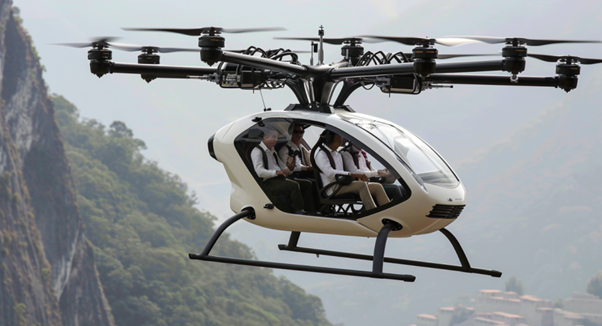
Indonesia stands at the threshold of a new economic sector with the potential to transform industry, logistics, agriculture, security, and public service delivery: the Low Altitude Economy (LAE). This concept encompasses all economic activities conducted within low-altitude airspace—generally below 1,000 meters—enabled by technologies such as drones, autonomous aerial systems, urban air mobility, airborne sensors, artificial intelligence, and digital communications networks.
In many countries, the Low Altitude Economy is increasingly recognized as the next frontier of economic development. Drones are no longer viewed merely as tools for aerial photography or surveying; they are emerging as strategic economic infrastructure capable of generating new business models, improving cross-sector efficiency, and creating new sources of national growth.
Indonesia possesses extraordinary potential in this domain. As an archipelagic nation comprising more than 17,000 islands, with thousands of kilometres of power transmission lines, roads, pipelines, telecommunications towers, plantations, and disaster-prone regions, the demand for aerial data and drone-enabled services is inherently substantial.
The fundamental question, however, is whether Indonesia has established a governance framework capable of transforming this potential into a sustainable national competitive advantage. Alternatively, does the current regulatory approach remain overly focused on risk control, thereby constraining industrial expansion and technological innovation?
In my view, the most fundamental challenge in developing drone and the Low Altitude Economy in Indonesia lies in the contest between two competing policy paradigms. The first is control-oriented regulation, in which regulatory systems are designed primarily to impose restrictions and mitigate operational risks. The second is industrial–innovation ecosystem development, in which regulation functions as a strategic instrument to foster industrial growth, attract investment, and accelerate innovation. The future of Indonesia’s drone industry will be determined largely by which of these paradigms becomes dominant.
In the public policy and innovation studies literature, a growing body of research demonstrates that regulation does not merely function to control risks; it can also shape markets, stimulate innovation, and guide industrial development. Borrás and Edquist (2019) argue that modern innovation policy should be designed to strengthen national innovation systems. Mariana Mazzucato (2021) further emphasizes that countries that successfully build strategic industries are those in which the state acts as a market-shaping state, rather than merely a market overseer.
Nevertheless, research on drones in Indonesia remains dominated by aviation safety perspectives, technical considerations, and security concerns. Few studies have comprehensively examined drone regulation as an instrument of industrial policy, innovation ecosystem development, and national strategy for building the Low Altitude Economy. This academic gap must be addressed. Drones should be analysed not solely as aviation technologies, but as economic platforms that intersect with industrial policy, digital economy development, artificial intelligence, telecommunications, and airspace governance.
Indonesia has already established an operational legal basis for drone activities through Ministry of Transportation Regulations No. 37 of 2020 and No. 63 of 2021. These regulations provide important foundations regarding operational zones, flight permits, altitude restrictions, and safety requirements. From an aviation safety perspective, these are significant achievements. From an economic development perspective, however, the existing framework remains insufficient.
Current regulations are primarily focused on risk classification, operational licensing, airspace restrictions, and safety compliance. Meanwhile, critical components required to build a robust Low Altitude Economy are not yet comprehensively regulated, including Beyond Visual Line of Sight (BVLOS) operations, Unmanned Traffic Management (UTM), drone corridors, drone ports, the aerial data economy, drone logistics, Drone-as-a-Service (DaaS), and integration with smart city systems. In other words, Indonesia has established operational rules, but it has not yet developed a comprehensive national ecosystem architecture.
Empirical evidence indicates that demand for drone-based services in Indonesia continues to increase. Mining, oil palm plantations, energy and utilities, construction, telecommunications, disaster management, security services, and logistics for frontier, outermost, and underdeveloped regions (3T areas) all demonstrate strong and growing demand. Business models such as Drone-as-a-Service (DaaS) have proven particularly effective because they convert drone adoption from capital expenditure (CAPEX) into operational expenditure (OPEX), thereby lowering barriers to adoption.
Despite this promising outlook, industrial adoption remains fragmented. Many initiatives are still limited to pilot projects, lack standardized implementation frameworks, and are not supported by sufficiently mature institutional infrastructure. This condition reveals a substantial gap between significant market potential, adequate technological readiness, and a national governance framework that remains insufficiently integrated.
Based on these academic, regulatory, and empirical gaps, several fundamental questions emerge. Has Indonesia’s drone regulatory framework been designed to build a national industry, or does it remain confined to risk-control functions? How does institutional fragmentation affect the pace of innovation and investment? What lessons can Indonesia draw from international best practices? What governance model is most appropriate for Indonesia? And what strategic actions should be undertaken over the next five to ten years?
REFERENCES AND BEST PRACTICES
The United States: Regulatory Sandboxes and Unmanned Traffic Management
The Federal Aviation Administration (FAA) provides one of the clearest examples of how regulation can serve as a catalyst for innovation rather than a barrier to it. Through initiatives such as the UAS Integration Pilot Program and the BEYOND Program, the FAA has enabled state governments, local authorities, and private-sector actors to test emerging drone technologies under controlled operational conditions.
In collaboration with NASA, the FAA has also developed the Unmanned Traffic Management (UTM) system, a digital architecture designed to integrate drones safely and efficiently into civilian airspace. This framework supports remote identification, flight authorization, traffic deconfliction, and real-time situational awareness.
The principal lesson from the United States is that regulators can act as facilitators of experimentation and institutional learning, rather than merely as enforcement authorities. By creating structured opportunities for testing and adaptation, regulatory institutions can accelerate both technological innovation and market development.
The European Union: U-Space and Regional Harmonization
The European Union Aviation Safety Agency (EASA) has established the U-Space framework to support the safe and scalable integration of drones across Europe. U-Space combines digital services for identification, flight authorization, deconfliction, and operational awareness within a harmonized regulatory environment.
This approach demonstrates the critical importance of interoperability, standardization, and regulatory harmonization across jurisdictions. By developing common technical and legal standards, the European Union has reduced fragmentation and created a more predictable environment for investment and cross-border operations.
China: The Low Altitude Economy as a National Strategic Agenda
China represents the most ambitious and coordinated example of Low Altitude Economy development. The Chinese government has elevated the Low Altitude Economy to the level of a national strategic priority, integrating drone manufacturing, electric vertical take-off and landing (eVTOL) aircraft, aerial logistics, drone ports, artificial intelligence analytics, and large-scale state-backed financing.
Provincial governments compete to establish drone industry clusters, while companies such as DJI have achieved global market leadership. China’s experience illustrates that sustained industrial success emerges when regulatory policy, industrial strategy, research and development, and investment policy are aligned within a unified national vision.
Singapore: Living Laboratories and the Smart Nation Model
Singapore has adopted a highly agile approach to drone governance by creating dedicated testing corridors in ports and dense urban environments. As part of its Smart Nation strategy, Singapore uses real-world experimentation to evaluate regulatory frameworks and operational models before large-scale deployment.
Singapore demonstrates the value of governance agility and regulatory experimentation. Even with a limited geographic footprint, a country can become a global innovation leader by rapidly testing and refining emerging technologies within a coherent institutional framework.
Japan: Drone Logistics for Rural Service Delivery
Japan has leveraged drone technology to address demographic decline and logistical challenges in remote and aging communities. Drone-based delivery systems are being used to transport medicine, food, and essential supplies to regions where conventional logistics are increasingly inefficient.
Japan’s experience highlights the importance of aligning drone policy with clearly defined societal needs. By integrating drone operations into public service delivery, Japan has demonstrated how emerging technologies can generate both economic and social value.
Strategic Lessons for Indonesia
Taken together, these international experiences reveal a common principle: countries that lead in drone development do not rely solely on restrictive aviation rules. Instead, they establish integrated governance systems that combine regulatory certainty, industrial policy, innovation support, infrastructure development, and strategic investment.
The overarching lesson for Indonesia is clear. Competitive advantage in the Low Altitude Economy will not be achieved through regulation focused exclusively on risk control. It will depend on the state’s ability to design and orchestrate a comprehensive ecosystem in which safety, innovation, and industrial development advance in parallel.
DISCUSSION
Gap Analysis: Where Does Indonesia Stand Today?
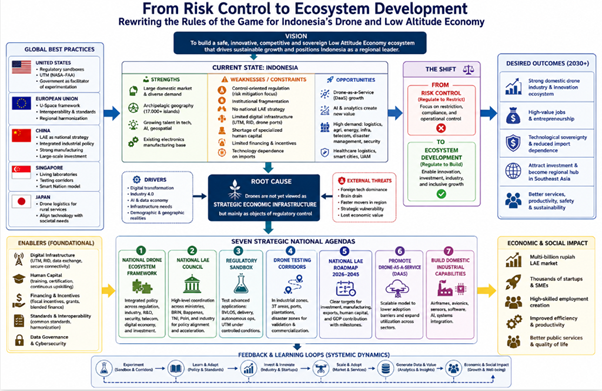
When compared with countries that have moved more decisively in developing the Low Altitude Economy, Indonesia occupies a paradoxical position. The country possesses many of the structural conditions required to become a regional leader, yet it continues to face significant institutional and regulatory constraints that limit its progress.
Indonesia’s strategic strengths are substantial. It has a large domestic market with diverse industrial demand. Its archipelagic geography creates a natural need for drone-enabled logistics, aerial mapping, and infrastructure monitoring. Demand from sectors such as mining, agriculture, energy, telecommunications, and disaster management is both immediate and scalable. Indonesia is also benefiting from a growing pool of technical talent in engineering, geospatial analytics, software development, and artificial intelligence. In addition, the country has an existing electronics manufacturing base that could be expanded to support domestic drone production and systems integration.
Despite these strengths, several structural weaknesses remain. The regulatory framework has not yet evolved into a pro-industry instrument capable of accelerating innovation and investment. Institutional fragmentation across ministries and agencies continues to slow decision-making and reduce policy coherence. Indonesia has not yet developed a national Unmanned Traffic Management (UTM) system, nor has it established dedicated drone corridors for systematic testing and commercial deployment. Operator certification standards are still developing, and financing mechanisms for innovation remain limited.
At the same time, the opportunities are considerable. Drone-as-a-Service (DaaS) offers a scalable business model that lowers adoption barriers for enterprise users. Advances in artificial intelligence and aerial analytics are creating new value propositions based on real-time decision support. Healthcare logistics, infrastructure monitoring, precision agriculture, and future urban air mobility applications represent major sources of long-term economic growth.
These opportunities, however, are accompanied by serious threats. Foreign technology providers continue to dominate critical platforms and components. Highly skilled Indonesian professionals may seek opportunities abroad if domestic ecosystems remain underdeveloped. Neighbouring countries are moving more rapidly to establish enabling regulatory environments. Continued dependence on imported technologies also raises concerns about strategic vulnerability and limited domestic value creation.
Taken together, this assessment suggests that Indonesia possesses strong market fundamentals but remains constrained by governance and institutional shortcomings. The country has the ingredients to lead, but not yet the integrated framework required to convert potential into sustained competitive advantage.
Key Challenges in Developing Drones and the Low Altitude Economy
The first and most significant challenge is the persistence of control-oriented regulation. A regulatory approach that emphasizes restriction and risk avoidance, while essential for aviation safety, can significantly slow innovation if not balanced with mechanisms that enable experimentation and market development. Industry actors frequently face uncertainty regarding operational permits, Beyond Visual Line of Sight (BVLOS) approvals, spectrum use, and procedures for testing new technologies.
The second challenge is institutional fragmentation. Responsibilities are distributed across multiple ministries and agencies, each operating according to sector-specific mandates. In the absence of a single coordinating institution, policy development becomes fragmented, duplicative, and slow. This weakens investor confidence and hinders ecosystem development.
The third challenge is the absence of a formal national strategy. Indonesia does not yet have an official National Low Altitude Economy Roadmap that defines long-term priorities, investment targets, regulatory milestones, and industrial objectives. Without such a strategy, development remains reactive and uncoordinated.
The fourth challenge concerns digital infrastructure. Foundational systems such as Unmanned Traffic Management, remote identification, secure data exchange, and drone port networks have not been developed systematically. Without these enabling infrastructures, large-scale commercial deployment will remain difficult.
The fifth challenge is the shortage of specialized human capital. While technical talent is expanding, the number of certified drone pilots, geospatial analysts, AI engineers, and regulatory specialists remains insufficient to support rapid industry growth.
The sixth challenge is the limited availability of financing and incentives. Indonesia has yet to establish dedicated fiscal incentives, public funding mechanisms, or blended finance instruments tailored to the drone industry and the broader Low Altitude Economy.
The seventh challenge is technological dependence. Domestic capabilities in core components, avionics, sensors, and software remain limited, leaving Indonesia heavily reliant on imported systems and reducing opportunities for national industrial upgrading.
The Root Cause: Drones Are Not Yet Viewed as Strategic Economic Infrastructure
In my assessment, the most fundamental issue is not technological readiness, but policy perception. Drones are still treated primarily as objects of regulatory oversight rather than as enablers of economic transformation.
This perspective underestimates the strategic role that drones can play in the national economy. When viewed appropriately, drones constitute a form of digital infrastructure comparable to telecommunications networks, data centres, and transportation systems. They collect real-time information that supports planning, monitoring, automation, and decision-making across multiple sectors.
The data generated by drones is itself an economic asset. It enhances productivity, improves safety, reduces operational costs, and enables entirely new service-based business models. In this sense, the true value of drone technology lies not merely in the aircraft, but in the intelligence, analytics, and economic insights it produces.
Until this conceptual shift is reflected in national policy, Indonesia risks underutilizing one of the most promising technological and economic opportunities of the coming decade.
Way Forward: Seven Strategic National Agendas
To transform Indonesia from a passive consumer of drone technology into a leading producer of innovation and economic value, a comprehensive and coordinated national strategy is required. In my view, seven strategic agendas should become immediate national priorities.
The first priority is the establishment of a National Drone Ecosystem Framework. Indonesia needs a comprehensive policy blueprint that integrates regulation, industrial development, research and innovation, national security, telecommunications, the digital economy, and investment policy. This framework should serve as the overarching architecture for the development of the drone industry and the broader Low Altitude Economy.
The second priority is the creation of a National Low Altitude Economy Council. This body should function as a high-level coordination mechanism involving Kementerian Perhubungan Republik Indonesia, Kementerian Komunikasi dan Digital Republik Indonesia, Kementerian Perindustrian Republik Indonesia, Badan Riset dan Inovasi Nasional, Badan Perencanaan Pembangunan Nasional, the armed forces, the national police, and industry representatives. Its role should be to harmonize policies, accelerate decision-making, and ensure strategic alignment across sectors.
The third priority is the development of a regulatory sandbox. Such a framework is essential for testing advanced applications under controlled conditions, including Beyond Visual Line of Sight (BVLOS) operations, drone delivery, autonomous inspection, and Unmanned Traffic Management (UTM). Regulatory sandboxes allow policymakers to learn in real-world settings while maintaining appropriate safeguards.
The fourth priority is the establishment of drone testing corridors. These corridors should be located in industrial zones, frontier and underdeveloped regions (3T areas), ports, plantations, and disaster-prone areas. Dedicated testing environments would enable technology validation, operational standardization, and policy experimentation prior to nationwide deployment.
The fifth priority is the preparation of a National Low Altitude Economy Roadmap 2026–2045. This roadmap should define measurable targets for investment, manufacturing, exports, human capital development, and contribution to gross domestic product. A long-term strategic roadmap would provide regulatory certainty and align public and private investment decisions.
The sixth priority is the promotion of Drone-as-a-Service (DaaS) as a national adoption model. DaaS is the most practical and scalable business model for accelerating drone utilization across sectors because it allows users to access drone capabilities as an operational service rather than as a capital-intensive asset purchase.
The seventh priority is the development of domestic industrial capabilities. National efforts should focus on strengthening competencies in airframe manufacturing, avionics, sensors, software, artificial intelligence, and systems integration. Building these capabilities is essential for reducing import dependence and increasing domestic value creation.
The Economic Potential of the Low Altitude Economy
If managed strategically, the Low Altitude Economy could become one of Indonesia’s most important new engines of growth. It has the potential to generate thousands of technology startups and small and medium-sized enterprises, create tens of thousands of high-skilled jobs, improve operational efficiency across multiple sectors, enhance workplace safety, and establish a new source of long-term economic expansion.
Drone-as-a-Service alone could evolve into a multi-billion-rupiah industry annually. When combined with artificial intelligence, digital twins, and advanced analytics, the economic value and strategic relevance of the sector would expand significantly.
Implications for Government: The role of government must evolve from that of a passive regulator to that of an ecosystem orchestrator.
Public institutions should not be limited to issuing operational rules. They must also align institutions, reduce investment barriers, accelerate innovation, and build national competitiveness. The countries that lead in emerging technologies are those in which governments actively coordinate and shape the enabling environment.
Implications for Industry: Businesses should view drones not as a hardware business, but as a data-driven service platform.
The greatest value lies in analytics, automation, and decision support. Companies that focus on delivering actionable insights rather than simply operating aircraft will be best positioned to capture long-term market opportunities.
Implications for Universities: Universities have a critical role in developing the intellectual and technical foundations of the industry.
Higher education institutions should strengthen research in Remotely Piloted Aircraft Systems (RPAS), artificial intelligence for aerial systems, geospatial analytics, and technology governance. Collaboration among universities, industry, and government—the triple helix model—will be essential for sustaining innovation and talent development.
Implications for Investors: The Low Altitude Economy offers an exceptionally attractive investment opportunity.
The sector combines high growth potential, recurring revenue models, scalable digital platforms, and opportunities for regional expansion. For investors who enter early, the upside could be substantial as regulatory frameworks mature and commercial adoption accelerates across Southeast Asia.
CLOSING
Indonesia possesses all the essential prerequisites to become one of the largest and most dynamic Low Altitude Economy hubs in Southeast Asia. The country benefits from a vast domestic market, substantial industrial demand, a uniquely strategic archipelagic geography, a rapidly growing pool of technological talent, and strong momentum in digital transformation.
Yet potential alone does not automatically translate into competitiveness.
The principal challenge is no longer technological. The underlying technologies are already available. Market demand is real and expanding. Capital is increasingly accessible, and human talent continues to grow.
The most fundamental constraint lies in the national governance paradigm.
As long as drones are viewed primarily as objects of regulatory control, Indonesia will advance slowly and risk becoming little more than a consumer market for foreign technologies. Under such a scenario, the country will capture only a fraction of the economic value generated by the global expansion of drone technologies and the Low Altitude Economy.
By contrast, if regulation is repositioned as a strategic instrument for industrial development and innovation, Indonesia can build a robust domestic drone ecosystem, strengthen technological sovereignty, create high-value employment, and emerge as a leading player in the global Low Altitude Economy.
The strategic question facing Indonesia is therefore both simple and decisive:
Will the country continue to regulate in order to restrict, or will it begin to regulate in order to build? The answer to this question will determine whether Indonesia becomes a spectator or a leader in one of the most important technological and economic transformations of the coming decades.
References
Borrás, S., & Edquist, C. (2019). Holistic Innovation Policy: Theoretical Foundations, Policy Problems, and Instrument Choices. Oxford University Press.
DJI. (2024). Annual Industry and Market Insights. Shenzhen: DJI.
European Union Aviation Safety Agency. (2023). U-Space Regulatory Framework. Cologne: EASA.
Federal Aviation Administration. (2023). UAS Integration Pilot Program and BEYOND Program. Washington, DC: FAA.
International Civil Aviation Organization. (2023). Manual on Remotely Piloted Aircraft Systems (RPAS) (Doc 10019). Montreal: ICAO.
Kementerian Perhubungan Republik Indonesia. (2020). Peraturan Menteri Perhubungan Nomor PM 37 Tahun 2020 tentang Pengoperasian Pesawat Udara Tanpa Awak di Ruang Udara yang Dilayani Indonesia. Jakarta.
Kementerian Perhubungan Republik Indonesia. (2021). Peraturan Menteri Perhubungan Nomor PM 63 Tahun 2021. Jakarta.
Mazzucato, M. (2021). Mission Economy: A Moonshot Guide to Changing Capitalism. London: Allen Lane.
National Aeronautics and Space Administration. (2023). Unmanned Aircraft Systems Traffic Management Research. Washington, DC: NASA.
Organisation for Economic Co-operation and Development. (2021). Regulatory Approaches to Emerging Technologies. Paris: OECD Publishing.
Pierre, J., & Peters, B. G. (2020). Governance, Politics and the State (2nd ed.). London: Red Globe Press.