
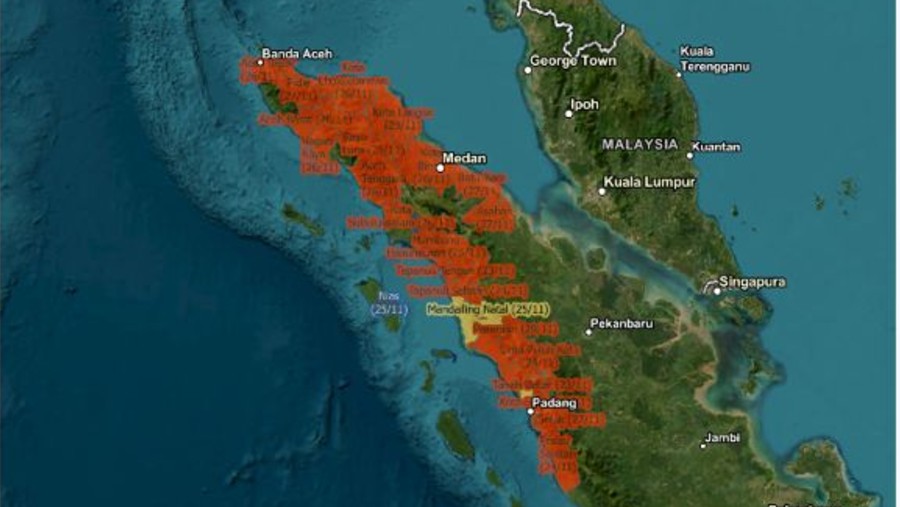

The floods and landslides that recently struck Aceh and several parts of Sumatra were widely described as natural disasters. Heavy rainfall was blamed, extreme weather was cited, and climate change became the convenient explanation. Yet framing these events as sudden or unavoidable overlooks a more uncomfortable truth: the disaster had been forming long before the rain began.
Across Sumatra, deforestation and land-use change have steadily weakened natural systems that once regulated water flow and protected communities. Forests in upstream areas—particularly within key watersheds (Daerah Aliran Sungai/DAS)—have been fragmented by logging, plantations, and infrastructure expansion. When rain falls on landscapes stripped of vegetation, water no longer infiltrates soil gradually; it rushes downstream, carrying sediment, debris, and destruction.
Aceh offers a telling example. Despite its special autonomy status and vast forest cover, pressure on its ecosystems has intensified. Several flood-prone areas are located downstream of degraded watersheds, where forest conversion has reduced the land’s capacity to absorb rainfall. Environmental assessments and spatial plans have long warned of these risks, yet development approvals have continued to outpace ecological considerations.
This is where Indonesia’s reality begins to resemble the moral lesson of The Lorax—though in a far more complex and political form.
In the film, environmental collapse is not caused by ignorance. It is driven by decisions made with full awareness of their consequences, justified by growth and necessity. In Indonesia, the “axe” is not held by a single actor. It is embedded within policy frameworks, licensing systems, and governance practices that allow ecologically sensitive areas to be treated as economically expendable.
The metaphor matters because it shifts attention away from nature as the sole culprit and toward decision-making structures. Rain does not cause floods in isolation. Floods emerge when land-use planning ignores watershed integrity, when forests are treated as commodities rather than protective infrastructure, and when environmental safeguards become procedural rather than substantive.
Scientific knowledge has never been absent. Hydrological studies consistently show that intact forests reduce runoff and stabilise river systems. Disaster risk maps identify high-risk zones across Sumatra’s river basins. Environmental impact assessments are legally required for large-scale land conversion. Yet these instruments often fail to influence final decisions, sidelined by economic urgency or political compromise.
The result is a pattern of reactive governance. Each disaster is followed by emergency response, temporary relief, and public statements of concern. Meanwhile, the structural drivers—forest degradation, weak enforcement, fragmented spatial planning—remain largely untouched. Over time, disasters become normalised, framed as recurring misfortunes rather than preventable outcomes.
Communities living along rivers in Aceh and Sumatra have been warning about these risks for years. Farmers notice changes in water flow. Villagers observe rivers turning murkier and floods arriving faster. Indigenous groups speak of forest loss disrupting ecological balance. These local observations align closely with scientific findings, yet they rarely shape policy in meaningful ways.
Here, the Lorax metaphor becomes less about nostalgia and more about accountability. The Lorax does not oppose development; he questions its cost and its distribution of risk. Similarly, environmental warnings in Indonesia are not anti-growth arguments. They are reminders that development choices allocate vulnerability—often pushing ecological and social risks onto communities least responsible for the decisions that create them.
What makes the situation particularly troubling is the illusion of protection. Laws exist. Institutions exist. Monitoring systems exist. But when enforcement is inconsistent and ecological thresholds are treated as flexible, protection becomes symbolic. Governance appears present, yet ecosystems continue to erode.
The image of a tree stump—common across Sumatra’s landscapes—captures this contradiction. It is not merely a remnant of a felled tree, but a marker of lost function. Once a watershed loses its forest cover, recovery is slow and uncertain. No amount of disaster response funding can fully replace the regulatory role that intact ecosystems once played.
Aceh and Sumatra are not anomalies. They are early warnings.
As climate change intensifies rainfall patterns, the consequences of ecological neglect will become more severe. Floods will arrive faster, landslides will become deadlier, and recovery will grow more expensive. The question is no longer whether warnings exist, but whether they are allowed to matter.
Indonesia does not lack voices that “speak for the trees.” Scientists, communities, and environmental advocates have been doing so consistently. What remains uncertain is whether governance systems are willing to listen—before the silence left behind is no longer metaphorical, but permanent.
Because when warnings are repeatedly unheeded, the disaster is no longer natural. It is institutional.

