
There is an irony we often ignore in school: we learn about sustainability in science class, yet every day we let waste pile up without meaning.
In the school cafeteria, leftover food ends up in the same place—fruit peels, wilted vegetables, unfinished drinks. Nothing about this habit seems “wrong.” It has simply become normal. But that’s exactly the problem: when something imperfect becomes routine, innovation loses its space to grow.
In cities like Tangerang Selatan, daily waste production has exceeded 1,000 tons. We often see this number in news reports or policy documents, but it rarely feels real in students’ everyday lives. Waste seems distant—when in fact, it is very close. It is in our hands, on our plates, and in the cafeteria trash bins.
So, the real question is no longer how much waste we produce, but what we do with it.
When Waste Becomes the Language of Science
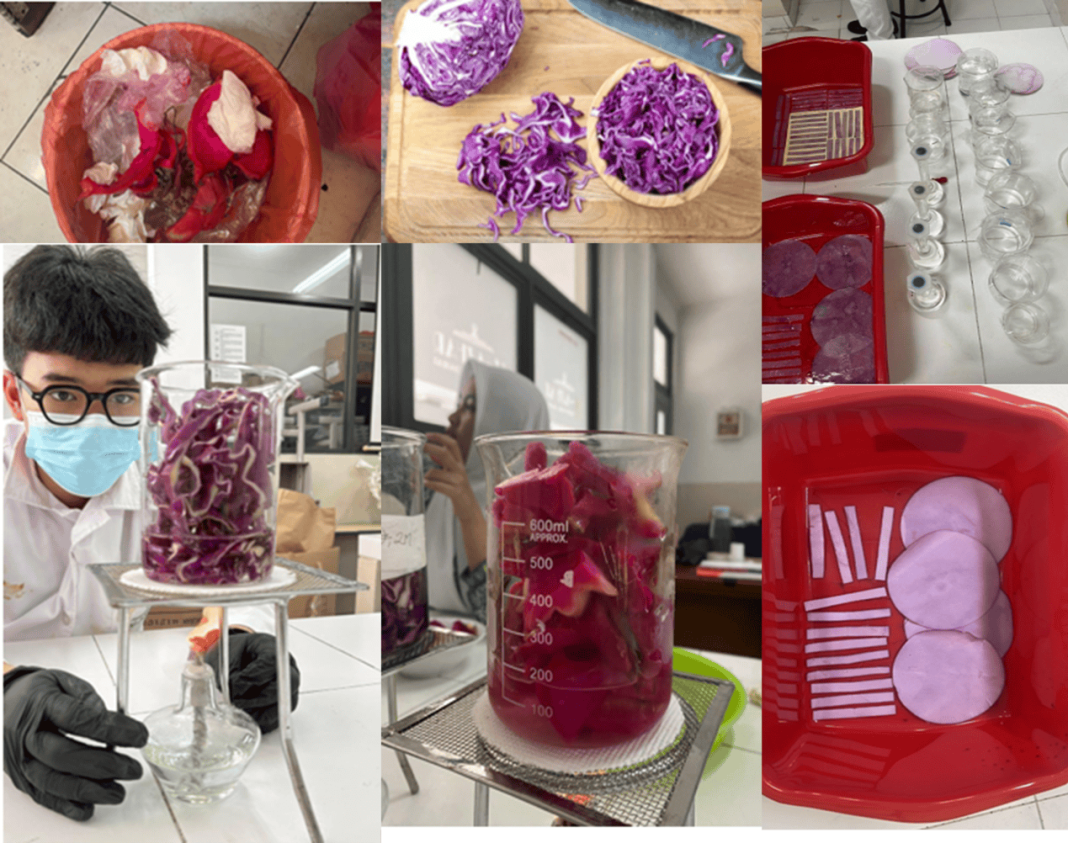
At SMA Al Azhar BSD, like in many schools, organic waste is part of daily life. Dragon fruit peels are among the most noticeable—bright in colour, large in volume, yet always ending up discarded.
But from a chemistry perspective, dragon fruit peels are far from useless. They are like a “mini laboratory” containing an important compound called anthocyanin. This natural pigment not only gives the peel its reddish-purple colour but also has a unique property: it changes colour depending on pH.
In other words, the colour we see is not just visual—it carries information.
This phenomenon is not new in science. However, in education, this potential is rarely explored seriously. Students are usually introduced to synthetic indicators—litmus paper, phenolphthalein, or universal indicators—ready-made tools with no story behind them.
This is where the gap between science and reality begins.
Science becomes something we use, not something we create. It is seen as a result, not a process.
Hylosica Paper: Innovation from Something Simple
From this concern came a simple idea: what if cafeteria waste could be turned into a learning tool?
The answer is Hylosica Paper—a natural pH indicator paper made from a combination of dragon fruit peel (Hylocereus polyrhizus) extract and red cabbage (Brassica oleracea).
Technically, the concept is simple. Anthocyanins from both materials are extracted, mixed, and absorbed into paper. When the paper is dipped into a solution, its colour changes depending on the acidity level.
But behind this simplicity lies a powerful shift in thinking.
Hylosica Paper is not just about replacing synthetic indicators with natural ones. It is about bringing science back to its context—to daily life, to the surrounding environment, and to real problems students face.
It transforms students from users into creators.
Why Do We Rely So Much on Synthetic Materials?
For years, synthetic pH indicators have been considered the standard in school laboratories. They are accurate, stable, and easy to use. But there are three important issues we often overlook.
First, cost. For schools with limited budgets, using synthetic indicators regularly can be expensive.
Second, environmental impact. Many synthetic indicators involve chemicals that are not eco-friendly. Individually, the impact may seem small—but over time, it adds up.
Third, education itself. When students only use ready-made tools, they miss the chance to understand how those tools are created.
This is the paradox of modern science education: we want students to think critically, but we don’t always give them the space to explore authentically.
From Knowledge Consumers to Knowledge Creators
Hylosica Paper offers a different approach. It doesn’t just provide answers—it raises questions:
How do we extract anthocyanins?
Why do colours change at different pH levels?
What happens when two pigment sources are combined?
Why aren’t the results always identical to the synthetic indicators?
These questions cannot be answered by reading alone. They must be experienced.
This is where Project-Based Learning becomes meaningful. Students are no longer passive learners—they actively participate in creating knowledge.
They learn that science is not just about right or wrong answers, but about exploration, trial and error, and improvement.
Science That Feels Real
One of the greatest strengths of Hylosica Paper is how closely it connects to everyday life.
The concept of pH is often seen as abstract. Numbers from 1 to 14 can feel distant and meaningless. But when students see colours change directly—from red to purple to green—the concept becomes real.
Even more importantly, they begin to realize that pH is everywhere:
It is in the water they drink.
It is in the soil where plants grow.
It is in the skincare products they use every day.
In other words, science is no longer separate from life—it becomes part of it.
Circular Economy in a School Setting
In global discussions about sustainability, the idea of a circular economy is becoming increasingly important. Hylosica Paper offers a simple example of this concept at the school level.
The idea is straightforward: waste is not thrown away but transformed into something useful.
Dragon fruit peels, once considered worthless, become raw materials for pH indicators. Leftover red cabbage enhances colour variation and improves the product.
The result is not just a tool, but a shift in perspective.
Students learn that the value of something is not defined by its current state, but by how we choose to use it.
Limitations as Part of Learning
Of course, Hylosica Paper is not perfect. In testing, synthetic indicators still outperform it in terms of precision and consistency, especially within certain pH ranges.
But this is exactly where its educational value lies.
Students don’t just use the tool—they evaluate it. They understand that every method has strengths and weaknesses.
This is an important lesson often overlooked: science is not about perfection, but about understanding limitations.
Rethinking What School Means
If we look more closely, Hylosica Paper is more than a chemical innovation. It reflects how we view education.
Is school just a place to memorize concepts?
Or is it a space to create solutions?
Are students merely receivers of knowledge?
Or are they agents of change?
The answers to these questions will shape the future of education.
A Small Beginning with Big Possibilities
Great innovations don’t always start in high-tech laboratories or with expensive equipment. Often, they begin with a simple awareness of everyday problems.
In this case, from something very ordinary: cafeteria waste.
Hylosica Paper shows that change doesn’t always have to be dramatic. Sometimes, it begins with a simple question:
“Is this really useless?”
And from that question, new possibilities emerge.
When Innovation Doesn’t Come from the System
There’s one question we rarely ask honestly in education:
Why does something like Hylosica Paper feel “unusual”?
If you think about it, it shouldn’t be.
Schools already have everything needed for innovation: students, teachers, real environments, and real problems. Those are the raw materials of creativity.
But most science learning still runs on repeat.
Experiments follow fixed procedures. The results are already known. There’s little space to question—let alone to create something truly new.
We are training a generation that is good at following instructions, but not always ready to solve problems.
In that context, Hylosica Paper is interesting not because it’s complex, but because it dares to break the pattern.
It wasn’t born from a rigid curriculum, but from awareness of the surrounding environment. From questioning habits. From the courage to try.
In other words, this innovation grew within the system—not because of it.
Education That Feels Too Far from Reality
One of the biggest problems in science education is the gap between theory and real life.
Students learn about acids and bases, but don’t connect them to everyday experiences. They memorize pH ranges, but don’t understand what they actually mean. They use indicators, but never ask where those indicators come from.
As a result, science feels like a list of concepts to remember—not a tool to understand the world.
Hylosica Paper cuts through that gap.
It connects pH concepts with cafeteria waste. It links chemistry theory with colours that students can actually see. It turns learning from abstract into something real.
More importantly, it changes students’ roles—from observers to doers.
They don’t just know that anthocyanins change colour.
They see it. Test it. Even produce it themselves.
And that’s the difference between learning about science and learning through science.
The Bigger Issue: A School Culture That Avoids Experimentation
If we go deeper, the issue isn’t just about teaching methods—it’s about academic culture.
In many schools, mistakes are still seen as failure, not part of learning. Experiments that don’t produce the “right answer” are often considered unsuccessful.
But in science, failure is part of the process.
Without space to try and fail, students will play it safe. They’ll follow existing procedures instead of creating something new.
Hylosica Paper, in this sense, teaches something more important than just pH indicators: the courage to experiment.
It opens up possibilities. It shows that results don’t have to be perfect to be meaningful.
From Classroom to Policy: Are We Ready to Change?
The next question is: can this kind of innovation grow?
The answer isn’t simple.
On the one hand, the idea is highly practical and easy to replicate. The materials are accessible. The process doesn’t require advanced technology. The educational value is clear.
But on the other hand, there are structural challenges.
Curricula are often too packed to allow deep exploration. Teachers are pressured to finish content. Assessment systems still focus on test results, not learning processes.
In this situation, exploratory projects are often seen as “extra,” not essential.
If we want innovations like Hylosica Paper to grow, change can’t just happen in the classroom. It has to reach the policy level.
Schools need flexibility. Teachers need support to experiment. Evaluation systems need to value the process—not just the outcome.
Without that, innovation will remain an exception—not a habit.
Science, Environment, and the Role of Young People
In the middle of a global environmental crisis, education can’t stay neutral.
Issues like waste, climate change, and sustainability aren’t just extra topics—they are realities that young people will directly face.
In this context, Hylosica Paper carries a bigger meaning.
It’s not just a lab tool—it’s environmental education in action.
Students learn that waste doesn’t have to be thrown away. They see how something considered useless can become valuable.
More than that, they feel that they have a role.
This matters. Because one of the biggest challenges in environmental issues is the feeling of helplessness. Many people think the problem is too big to solve.
But when change starts small—from a school cafeteria, from a strip of indicator paper—the story changes.
From “there’s nothing we can do” to “we can start here.”
Innovation as a Movement, Not Just a Project
Too often, school innovation stops at being a project.
It’s made for a competition, presented, then forgotten.
What we really need is not just projects—but movements.
Imagine if Hylosica Paper wasn’t a one-time experiment, but part of the learning system. If every year, new students improve and develop it.
If cafeteria waste were regularly processed into lab materials.
If schools had ongoing science-and-environment-based programs.
The impact wouldn’t just be on learning—it would shape school culture.
Schools would no longer be just places to study, but spaces to innovate.
Limitations as Starting Points
As discussed, Hylosica Paper still has limitations—especially in precision and storage stability.
But in innovation, limitations aren’t the end. They’re the beginning.
They open new questions:
- How can we improve colour stability?
- Are there natural stabilizers that can be added?
- How can we standardize colour readings more accurately?
- Can this be developed into other forms, like liquid or tablets?
These questions can become the next research steps—at the school level and beyond.
This is how a simple idea can grow into a sustainable research ecosystem.
The Role of Teachers: From Instructor to Innovation Facilitator
In all of this, teachers play a crucial role. They are no longer simply delivering material but guiding exploration and nurturing curiosity in the classroom. This shift is not easy—it requires courage to step beyond familiar routines and embrace uncertainty as part of the learning process. Teachers must be willing to let go of total control and allow students to navigate their own questions and discoveries. Yet, this is precisely where real transformation begins. When teachers create space for students to try, question, and even fail, learning becomes more dynamic, meaningful, and alive. Students are no longer passive recipients, but active participants in knowledge creation. Hylosica Paper is not just a student project; it reflects a supportive learning ecosystem where creativity, experimentation, and collaboration are encouraged, allowing students to develop a deeper understanding, confidence, and a genuine connection to science.
Toward a More Relevant Future of Education
At the end, the bigger question is: where is our education heading?
Do we want to keep the old model focused on memorization and exams?
Or move toward learning that is contextual, creative, and based on real problems?
Hylosica Paper may be a small example—but it shows a clear direction.
That education can be more relevant.
That science can feel more grounded.
That innovation can come from the simplest places.
Closing: Hope from Something Simple
Big change doesn’t always start with big policies.
It often begins with small, consistent actions.
From a student who sees trash differently.
From a project taken seriously.
From the courage to try something new.
Hylosica Paper is proof that hope exists.
That creativity can grow even in limitations.
Those solutions can come from problems.
That innovation is still possible—even in routine.
And maybe, the future of education won’t be defined by how much we teach—
But by how much space do we give to create?