
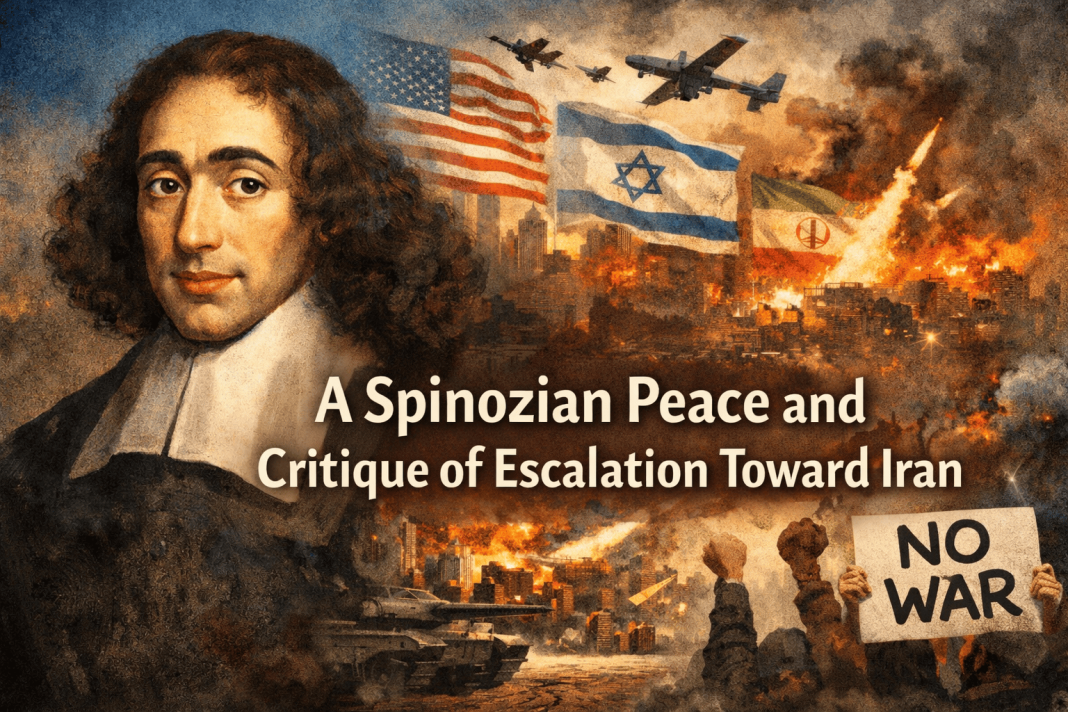

On February 28, 2026, the United States and Israel launched major strikes on Iran, prompting retaliation across the region and raising fears of a wider war. In the chaotic aftermath, information battles erupted over the fate of Iran’s Supreme Leader, with conflicting reports intensifying uncertainty.
By March 1, Iranian state media and some international outlets reported that Ayatollah Ali Khamenei had been killed, heightening shock and fears of a leadership vacuum. The crisis quickly reached the UN Security Council, where the UN Secretary-General condemned the attacks and warned of uncontrolled escalation unless diplomacy returns. China and others urged an immediate ceasefire and renewed talks.
Baruch de Spinoza helps explain the current crisis. For him, peace is not simply the absence of war. It is a political condition where people live securely without being ruled by fear, and where state power does not crush citizens’ freedom. Peace endures only when institutions can manage conflict without producing hatred.
This matters because Spinoza’s “affects” are not just private emotions. They spread among people through language, images, and collective moods, becoming political forces. Étienne Balibar develops this insight: politics is shaped by a “multitude” whose feelings and stories can align for solidarity or for war. Leaders often seek quick unity by amplifying one dominant emotion, panic, revenge, or humiliation. But such unity is fragile and depends on keeping an enemy in view.
That is the risk in escalation toward Iran. If security means striking first or striking harder, war begins to justify itself: each attack invites retaliation, and retaliation becomes the excuse for the next attack. This pattern reflects a wider global trend where force is normalized, and restraint is treated as weakness.
Venezuela shows how “regime-change” politics can normalize coercion. In 2019, the U.S. recognized Juan Guaidó as Venezuela’s “interim president” and intensified pressure for political change. In early 2026, Nicolás Maduro was taken into U.S. custody to face charges, an action critics described as an unlawful abduction move that often deepens polarization rather than deliver stable transitions.
Palestine, especially Gaza, shows another pattern: long-running restrictions on people and goods, intensified with the 2007 blockade and tightened again after October 2023, have steadily undermined living conditions and entrenched despair and anger. Ukraine shows how an unfinished war becomes “normal”: UN human rights monitors say 2025 was the deadliest year for civilians since 2022. When repeated exceptions become routine, global peace erodes.
Spinoza and Balibar help us link these cases without ignoring their differences. The goal is not to say the causes or responsibilities are the same. Instead, it is to show how violence spreads between groups: precedents, tactics, and justifications all move from one place to another. When international law is seen as optional, when ‘prevention’ is used as an excuse, and ‘security’ is treated as a blank check, everyone learns the same lesson: power justifies itself. This idea is a threat to world peace.
So what does it mean to resist escalation, according to Spinoza?
First, it means pushing back against the politics of fear. Fear is useful in politics because it makes people focus on the short term and limits their moral thinking. Spinoza’s alternative is not naive pacifism, but a tough political realism: systems built on fear are unstable because fear leads to more fear. Lasting security comes from reducing the reasons for retaliation and stopping the spread of anger.
Second, it means supporting institutions that encourage restraint, especially international law and diplomacy. These systems are not perfect, but they are the only real alternative to a world where every conflict is solved by force. The UN Secretary-General’s condemnation of illegal strikes and his warning about a wider war should be seen as a call to restore trust in rules before the next dangerous precedent is set.
Third, it means creating a public culture that sees peace as a real political achievement. This includes lasting ceasefires, protected humanitarian access, monitored negotiations, and accountability that does not disappear when powerful countries are involved. If peace is ‘strength of soul’ (Spinoza), then in politics it is also the strength of institutions and of citizens who refuse to be ruled by panic.
Indonesia and the wider Global South have a special interest in this issue. When escalation becomes normal, it is often the ‘periphery’ that suffers first, through energy shocks, disrupted trade, humanitarian crises, and the loss of rules that smaller countries rely on. World peace is not just a slogan. It is what allows development, justice, and democracy to exist.
Spinoza’s warning is clear: when politics is driven by anger and fear, everyone loses freedom, even those who think they are gaining security. Our job is to break this cycle and show that peace is not a weakness, but the highest form of political intelligence.

