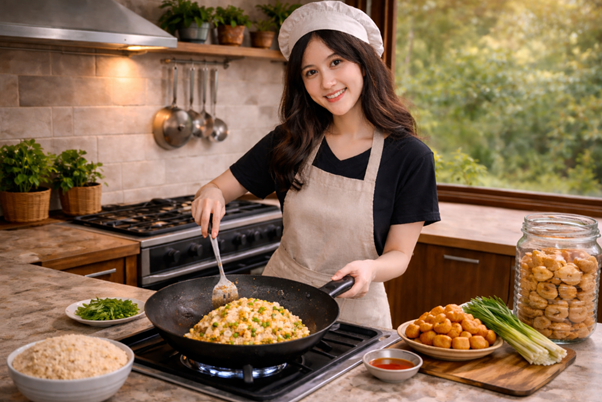

Mornings in Jakarta have a rhythm of their own. Somewhere between the impatient honk of traffic and the soft click of a rice cooker finishing its cycle, kitchens quietly come to life. Lids are lifted, containers are opened, and there it is—the familiar moment of truth. A bowl of rice from last night. A piece of chicken that somehow survived dinner. Vegetables that look… optimistic, at best.
And then comes the question we all know too well: is this still safe to eat, or am I about to take a culinary risk?
It is a small, almost mundane moment. But hidden inside it is something much bigger—something that connects directly to how a country manages its food.
We tend to think of food security as something distant, something handled in government offices and policy papers. It is about national stockpiles, imports, logistics, and price controls. It sounds serious, complex, and far removed from everyday life.
But here is the quiet contradiction. While institutions work hard to ensure food availability, households continue to waste it—little by little, day by day.
Not because people do not care. But because it has become a habit.
And that is exactly where the conversation needs to shift. Because managing a nation’s food does not begin in policy documents. It begins in kitchens—often in moments as simple as deciding what to do with leftovers.
Understanding this does not require advanced degrees or complicated theories. The science behind it is surprisingly simple. Food spoils because microorganisms grow. Bacteria, molds, and yeasts thrive when conditions allow them to. They need water, oxygen, and a comfortable temperature. Give them that, and they multiply happily. Take it away, and suddenly, their enthusiasm drops.
That is the entire game.
This is what basic food chemistry really is—not something abstract or intimidating, but a practical way of controlling the conditions that make food spoil. It is not about stopping time, but slowing it down just enough.
Take drying, for instance. It is one of the oldest preservation methods in human history, and it still works beautifully today. Remove water from food, and you remove the very thing microbes depend on to survive. No water, no growth. No growth, no spoilage—at least not quickly.
Indonesia is already familiar with this. Dried fish, sun-dried chilies, fruit chips—they are everywhere. Yet, in many modern kitchens, this simple method is often overlooked. Overripe bananas go straight to the trash instead of becoming dried snacks. Herbs wilt quietly in the fridge when they could have been preserved.
It is a small missed opportunity, repeated over and over again.
Drying is not just about making food last longer. It is about giving it a second form. While some heat-sensitive vitamins may decrease, minerals remain, and the food becomes lighter, more compact, and far easier to store. It is less about loss, and more about adaptation.
Then there is salt, an ingredient that quietly does far more than improve flavour. For centuries, it has been one of the most reliable preservation tools available. Its effectiveness comes from a simple principle. Salt draws water out—from the food, and from the microorganisms living on it. Without water, microbial life struggles to survive.
That is why salted fish can endure conditions that would spoil fresh fish in hours. It is not magic. It is chemistry doing its job.
Of course, modern kitchens require balance. Too little salt, and the effect is weak. Too much, and it becomes a health concern. The goal is not to turn everything into salted fish, but to understand how a small adjustment can make a meaningful difference.
If drying and salting work by taking things away, fermentation works by adding something new. It introduces beneficial microorganisms that take control of the process. These microbes produce acids, lowering the pH and creating an environment where harmful bacteria cannot easily survive.
What happens next is almost poetic. Food does not simply last longer—it changes. It becomes more complex in flavour, often easier to digest, and sometimes even more nutritious.
This is perfectly illustrated in tempe, a humble yet powerful example of how fermentation transforms soybeans into something richer in both taste and nutritional value. Similarly, pickled vegetables take something ordinary and give it a longer, brighter life.
Fermentation is not preservation in the traditional sense. It is evolution.
Another method, often hiding in plain sight, is the use of oil. At first glance, it might seem unrelated to preservation. But oil plays an important role by blocking oxygen. Since oxygen contributes to spoilage through oxidation and supports certain microbial activity, limiting its presence slows the process down.
This is why sambal often lasts longer when covered with a layer of oil. It is a simple barrier, but an effective one.
Of course, this method comes with a quiet warning. The food must be properly cooked and relatively dry. Otherwise, trapped moisture beneath the oil can create the perfect environment for unwanted microbial growth. In other words, it works beautifully—until it does not.
Then there is the topic that often gets unfair treatment: leftovers.
Leftover food tends to carry a certain stigma, as if it is somehow less appealing or less worthy. But in reality, it is one of the most practical tools for reducing waste.
The key is not to avoid leftovers, but to handle them properly. Reheating is not just about making food warm again. It is about making it safe. Bringing food to a sufficiently high temperature helps eliminate microorganisms that may have developed during storage.
And beyond safety, there is creativity.
Rice becomes fried rice.
Vegetables find new life in soups or stir-fries.
Chicken transforms into sandwiches or wraps.
Leftovers are not the end of a meal. They are the beginning of another.
Storage, too, plays a crucial role. Air, light, and humidity are constant threats to food quality. Exposure accelerates oxidation, reduces nutritional value, and encourages microbial growth. The solution is often simple—seal food properly, store it carefully, and limit unnecessary exposure.
Even traditional practices, like placing bay leaves or garlic in storage containers to deter insects, reflect an intuitive understanding of these principles. They may not sound scientific, but they are grounded in generations of observation.
Throughout all of this, one idea remains essential. Preserving food should not come at the expense of its nutritional value. Overheating, repeated reheating, and poor storage can all degrade nutrients. The goal is balance. Food should last longer, but it should also remain worth eating.
When these small practices are viewed together, something larger begins to emerge. They are not just techniques. They represent a shift in mindset.
Food is no longer something to use and discard. It becomes something to manage, extend, and respect.
And this shift has implications far beyond the household.
When families waste less food, demand becomes more stable. When food lasts longer, pressure on supply systems decreases. When consumption becomes more thoughtful, the entire system becomes more resilient.
Food security, then, is not only about supply. It is also about behaviour.
What makes this approach powerful is its simplicity. It does not require expensive tools or advanced technology. It relies on knowledge that is already accessible and actions that can be taken immediately.
There is a tendency to believe that meaningful solutions must be complex. That science must be difficult to be useful. But in this case, the opposite is true. The most effective strategies are the ones simple enough to be practiced daily.
Drying food under the sun. Adding a measured amount of salt. Allowing fermentation to happen. Storing food in airtight containers. Reheating leftovers properly.
None of these actions are extraordinary. But together, they matter.
In a country as large as Indonesia, change does not always begin with sweeping reforms. Sometimes, it begins with small habits repeated across millions of homes.
The kitchen, in this sense, becomes more than just a place to cook. It becomes a space of decision-making. A place where choices are made every day—whether to waste or to save, whether to ignore or to manage.
These choices may seem small. But they add up.
The next time a refrigerator door is opened and a container of leftover food is found, it might be worth pausing—not out of doubt, but out of awareness. That simple decision, whether to keep, transform, or discard, is not just about one meal.
It is part of something bigger.
Because managing a nation’s food does not always start with grand strategies.
Sometimes, it starts with what is already sitting in your fridge—and what you choose to do with it.