
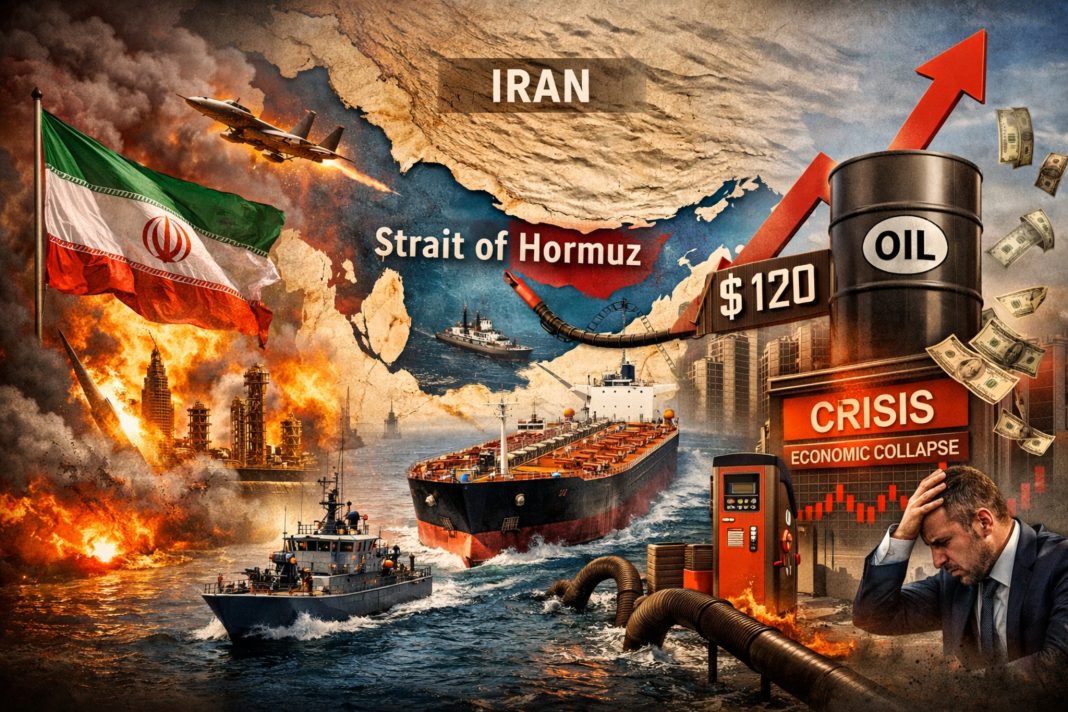

The joint military strike conducted by the United States and Israel against Iran in February 2026 represents more than a regional security escalation; moreover, it marks a high-stakes event with systemic economic implications. The strategic targets lie within a geography that governs one of the most vital arteries of global energy circulation. Unsurprisingly, energy markets reacted immediately, reflecting fears that oil flows through the Strait of Hormuz, the narrow maritime corridor between Iran and Oman, could be disrupted.
Markets instinctively recognized a fundamental reality: conflict involving Iran cannot be interpreted merely as a localized confrontation. Instead, it carries the potential to trigger a systemic supply shock. Investor behavior quickly shifted toward assessing risks to global energy stability rather than military outcomes alone. The volatility that followed illustrates how modern financial systems internalize geopolitical risk through expectations about energy availability and price stability.
From a broader energy-geopolitical perspective, escalation toward Iran appears neither isolated nor accidental. Early in 2026, U.S. intervention in Venezuela led to a political realignment and the reopening of its oil sector to Western companies. Viewed together, these developments suggest a larger strategic recalibration: simultaneous repositioning around two critical energy epicenters. Venezuela holds the world’s largest proven oil reserves, while Iran occupies a pivotal position near the primary transit route of global oil distribution through the Strait of Hormuz.
Following Washington’s relaxation of sanctions and expanded permissions for American energy firms to manage Venezuelan production and exports, U.S. energy policy appears to have evolved beyond containment toward structural re-engineering of global supply systems. The emerging pattern indicates an attempt to influence not only production capacity but also chokepoints in distribution.
The strategic logic connecting Caracas and Tehran is therefore less ideological than structural. Venezuela represents supply control, the management of reserves, while Iran represents transit control, the capacity to influence the flow of energy through a critical maritime bottleneck. Classical political economy offers a clear principle: actors capable of influencing both production and distribution indirectly shape global price formation.
Some policy analysts interpret Washington’s Venezuelan policy shift as an effort to stabilize markets by increasing supply and dampening price volatility. However, when combined with military pressure on Iran, a more strategic interpretation emerges: reducing the ability of non-aligned actors to weaponize energy disruptions. This resembles what analysts describe as an energy corridor doctrine, where global stability depends on maintaining controllable energy flows. Venezuela serves as a long-term supply stabilizer, while pressure on Iran aims to minimize the geopolitical leverage embedded in the Hormuz chokepoint.
Thus, the issue at stake transcends regional rivalry. What is unfolding concerns the architecture of twenty-first-century energy power, an attempt to ensure that global energy fluctuations remain governed by systems aligned with U.S. economic and security networks rather than by strategic challengers.
The Energy Artery of the Global Economy
The Strait of Hormuz is not merely a shipping lane; it is arguably the most critical energy chokepoint on Earth. Approximately 20-21 million barrels of oil per day transit this narrow corridor, accounting for roughly one-fifth of global oil consumption. Around a quarter of the seaborne oil trade and nearly 20 percent of global LNG shipments depend on this passage. Notably, about 84 percent of oil exports moving through Hormuz are destined for Asian markets, representing an annual economic flow estimated at nearly USD 600 billion from oil trade alone. Energy economists frequently describe Hormuz as the “bloodstream of globalization.” Without continuous energy circulation, global supply chains cannot function, regardless of logistical efficiency elsewhere.
A comparison with other maritime chokepoints clarifies its singular importance. The Strait of Malacca handles a large share of global manufacturing and trade shipping; the Suez Canal facilitates approximately 12 percent of global commerce; and the Bab el-Mandeb Strait connects Asian and European trade routes. Yet these corridors primarily enable goods movement. Hormuz determines whether the global economy possesses the energy required to operate at all. Without energy input, industrial production halts before distribution networks even begin functioning.
The Looming Energy Crisis
The uncertain trajectory of the Iran versus US-Israel confrontation introduces layered economic risks rather than linear consequences. Several scenarios concern policymakers and markets alike.
First, energy price shocks remain the most immediate threat. Analysts warn that severe supply disruption could push oil prices beyond USD 150 per barrel. Such increases would cascade across economies through rising transportation costs, manufacturing expenses, and inflationary pressure.
Second, global imported inflation could intensify. Energy functions as a foundational input across production systems; therefore, oil price increases translate directly into higher food prices, logistics costs, electricity tariffs, and fertilizer expenses. Economists refer to this phenomenon as the second-round inflation effect, where energy shocks propagate through entire economic structures.
Third, financial market instability is highly probable. Equity and bond markets exhibit acute sensitivity to geopolitical risks involving Iran because energy disruption represents a systemic threat. Investors typically rebalance portfolios toward safe-haven assets such as gold or energy commodities during such uncertainty.
Fourth, logistical costs are already rising. Oil tanker freight rates have climbed to multi-year highs, driven by escalating war-risk insurance premiums and operational uncertainty in the region.
Limits of Diversification and Strategic Mitigation
The United States and its allies have pursued mitigation strategies to reduce dependence on Hormuz, including energy diversification, expansion of OECD strategic petroleum reserves, increased US shale production, and construction of pipeline bypass routes in Saudi Arabia and the UAE. However, these alternatives collectively handle only a fraction of the roughly 20 million barrels per day typically passing through the strait. Diversification reduces risk exposure but does not eliminate structural dependency. The global energy system remains geographically concentrated, and Hormuz continues to function as an irreplaceable node within it.
The central question is no longer whether another energy crisis will emerge, but whether policymakers possess the strategic foresight to act before energy fully transforms from an economic commodity into a geopolitical weapon.

