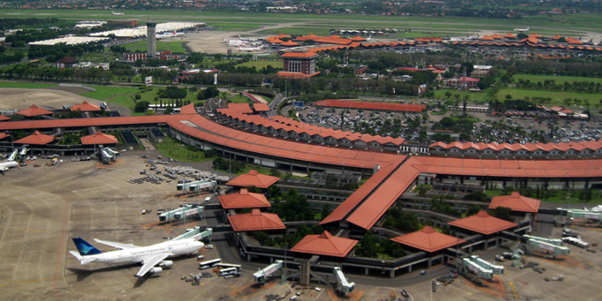

Airports are not merely physical infrastructures; they are complex public institutions that require mature and robust governance. The IATA Airport Governance Toolkit provides a comprehensive framework for how airport governance should function within a multilayered system involving governments, regulators, airport operators, airlines, safety authorities, communities, and international standards. Indonesia has built numerous airports over the past two decades, yet strengthening governance has become an urgent priority to ensure that its aviation ecosystem develops effectively, safely, and sustainably.
This article unpacks the core governance concepts articulated by IATA, connects them to Indonesia’s realities, and explores how optimizing existing institutions and structures can create world-class airport governance without establishing new entities. It argues that governance strength lies in aligning mandates, ensuring transparency, fostering effective coordination, and maintaining consistent implementation—not in institutional proliferation. Through an in-depth analysis of IATA’s five governance domains—policy and regulation, community and environment, safety and security, operations, and infrastructure project management—this article provides a strategic intellectual map for Indonesia’s journey toward adaptive and credible modern airport governance.
Airports as Public Institutions That Reflect a Nation’s Standing
Every modern nation understands that an airport is far more than a place where aircraft land and take off. It is a site of national representation, a centre of economic exchange, a logistical node, a space of diplomacy, and a symbol of a country’s capacity to manage complexity. An airport is a public arena: it is the entry point through which the world evaluates the quality of government, regulatory discipline, the ethics of public service, and a state’s ability to safeguard its citizens.
At the same time, an airport is a highly standardized technical institution. Its operations are guided by ICAO, governed by national authorities, operated by professional airport companies, supervised by safety regulators, and connected to the global network of airlines, cargo operators, and the aviation industry. For this reason, airport governance is not an issue of a single institution—it is an ecosystem issue.
Indonesia currently stands at a pivotal moment. Connectivity, economic mobility, and passenger growth are rising rapidly. The construction of numerous new airports signals a strong determination to break regional isolation and enhance competitiveness. Yet physical infrastructure is only one side of the coin. The other side—less visible but far more decisive—is governance.
Airport governance is a test of state maturity.
This is the central message of IATA’s thinking. Infrastructure can be built in two or three years, but orchestrating how various actors operate within an airport ecosystem requires institutional strategy, consistency, and integrity. The IATA Airport Governance Toolkit provides a scientific, comprehensive, and practice-oriented lens for this.
This article examines the toolkit’s core ideas, critiques, and contextualizes them within Indonesia’s conditions, and explains how optimizing existing structures can deliver resilient airport governance.
IATA’s Governance Framework: A Multilayered System
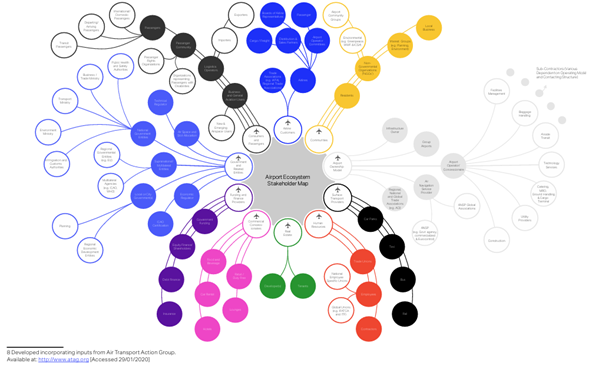
IATA outlines that airport governance operates across multiple interconnected layers. At the international level, ICAO establishes binding global standards. At the national level, governments set policy directions, provide legal frameworks, and ensure public mandates are met. At the regulatory level, civil aviation authorities guarantee that safety, security, and service standards are fulfilled. At the operational level, airport operators, airlines, air navigation service providers, ground handlers, and government agencies such as immigration and customs collectively deliver services.
Across all these layers, an airport’s role is not static but interactive. It operates in a balance of public interests, commercial objectives, and safety imperatives. IATA stresses that effective governance is not about regulating as much as possible but about clarity of roles, proper division of functions, and interconnection across responsibilities.
In practice, healthy airport governance should answer three fundamental questions: who decides, how decisions are made, and how those decisions are held accountable. When all three are clear, accountability takes shape; when any of them becomes ambiguous, issues arise.
Here lies Indonesia’s relevance. The country already has a comprehensive legal framework, functioning regulators, improving operators, and multiple ministries involved. But integration across actors is not always seamless. The challenge is not institutional absence but institutional optimization.
Understanding the Five IATA Governance Domains and Their Relevance to Indonesia
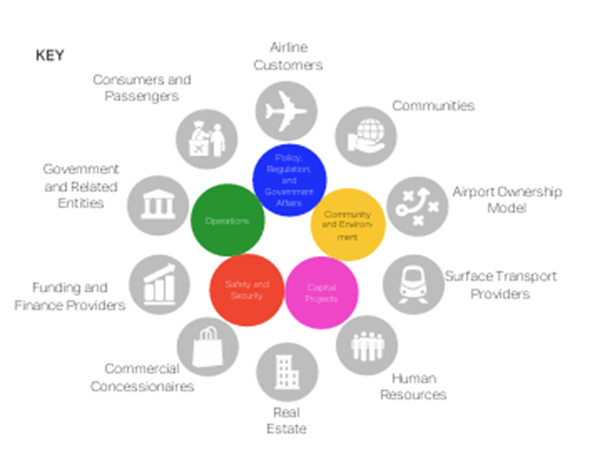
IATA categorizes airport governance into five major domains. They form an interconnected chain, each reinforcing the others. To understand how Indonesia can strengthen governance without creating new organizations, these domains must be interpreted conceptually and contextually.

- Policy and Regulation: Strategic Direction and Certainty
This domain underpins all others. It defines how a nation sets aviation policy objectives, how national law binds actors in the system, and how regulators ensure compliance with safety and security standards.
IATA emphasizes that policy must be consistent, transparent, and free from conflicts of interest. Indonesia already has all essential elements: aviation laws, derivative regulations, an established regulator, and a clear policy mandate. Challenges arise when implementation varies across regions and airports. Optimization can occur through better policy harmonization, more consistent economic regulation of airports, and improved transparency in slot allocation and tariff-setting.
Strengthening governance does not require new institutions—only better use of existing legal and policy frameworks and higher-quality coordination.
- Community and Environment: Meaningful Public Engagement
IATA underscores that airport sustainability depends heavily on relations with local communities. Airports built solely for strategic or economic reasons without listening to the surrounding communities will encounter resistance.
Effective public consultation is not one-way socialization; it is dialogue. Indonesia already has AMDAL processes, public consultation mechanisms, and coordination channels with local governments. Optimization involves improving information transparency, extending consultation periods, and elevating the quality of dialogue within existing mechanisms.
What is needed is not the establishment of new forums but the revitalization of existing ones, so they function meaningfully.
- Safety and Security: The Non-negotiable Pillars
Safety is the heart of airport governance. IATA describes it as a public mandate that must be carried out with utmost seriousness. Indonesia has developed its safety system significantly. The regulator is in place, investigation bodies exist, and airport operators adhere to operational safety standards.
Optimization includes strengthening coordination among safety units, clarifying reporting lines, enhancing safety culture, and ensuring ICAO standards are applied consistently across locations. The structures already exist; what is required is disciplined implementation.
- Operations: Harmonizing Actors in a Highly Interdependent Ecosystem
Airport operations are where all actors converge. Delays are never the responsibility of one party alone—they stem from interconnected factors such as gate availability, apron coordination, ground handling readiness, terminal capacity, and airside efficiency. IATA highlights the importance of collaborative mechanisms like Airport Collaborative Decision Making (A-CDM), ensuring all stakeholders see the same data and make decisions collectively.
Indonesia has adopted parts of A-CDM at major airports. Optimization can occur by deepening data integration, improving the discipline of daily coordination, and strengthening the operational coordinator’s role, all without creating new entities.
- Infrastructure Project Management: Planning and Operational Readiness
This domain explains how airport projects should be planned, consulted, financed, and prepared before operations begin. IATA stresses the importance of Operational Readiness and Airport Transfer (ORAT), master plan consistency, and adequate stakeholder involvement.
Indonesia has implemented ORAT to varying degrees. Optimization involves improving ORAT quality, strengthening internal oversight, and enhancing transparency in infrastructure planning processes. All tools already exist; the key is improving the depth and consistency of execution.
IATA’s Governance Principles: Values That Must Be Internalized
IATA asserts that airport governance must be rooted in five public values: fairness, participation, moral integrity, transparency, accountability, and efficiency. These values cannot remain abstract. They must appear in regulatory documents, decision-making processes, internal procedures, reporting systems, and stakeholder interactions.
In Indonesia’s context, fairness means equal treatment for airlines, businesses, and passengers. Participation means communities should be genuinely heard in expansion decisions. Moral integrity demands that public officials prioritize collective interests. Transparency requires that tariff policies, slot decisions, and infrastructure choices can be traced openly. Accountability ensures each unit fulfils its mandate. Efficiency requires optimal use of resources.
All five principles can be fully operationalized through existing mechanisms—what is needed is consistency, integrity, and an organizational culture aligned with these values.
Indonesia’s Governance Challenges: Fragmentation, Coordination, and Consistency
Indonesia has a vast, diverse, and geographically dispersed aviation ecosystem. Although the regulatory foundations exist, governance challenges stem not from institutional gaps but from uneven implementation.
First, policy fragmentation across units leads to inconsistent application, resulting in varying service standards and uncertainty for operators.
Second, coordination among on-the-ground stakeholders does not always flow smoothly. In airport ecosystems, coordination is not optional—it is vital. Effective airport operations depend on rapid, data-based collective decisions.
Third, operational standards are not always applied uniformly. Indonesia must ensure consistent implementation across all airports, not only major hubs.
These challenges do not require new institutions; they demand better organizational quality, stronger procedures, greater discipline, and refined inter-functional coordination.
Optimizing Governance
Based on IATA’s concepts and Indonesia’s realities, optimization can occur through four approaches: strengthening internal coordination, maximizing the legal framework, enhancing transparency, and reinforcing oversight functions.
Strengthened internal coordination can be achieved by reinvigorating existing technical forums, empowering operational coordinators, and ensuring that communication channels across units operate smoothly. These forums must function as daily coordination platforms rather than ceremonial gatherings.
Maximizing the legal framework means that existing regulations should be enforced consistently. No new rules are needed if current regulations are strong; what is required is decisive enforcement.
Transparency can be enhanced through the publication of operational data, openness in tariff policies, and public disclosure of slot-allocation decisions. Transparency reduces political pressure and enhances public trust.
Reinforcing oversight means optimizing existing bodies to ensure safety standards and service quality are met. Consistent internal oversight is more effective than creating new entities.
Most importantly, governance optimization is achieved by strengthening organizational culture: a safety culture, a transparency culture, a public service culture, and a coordination culture.

Summary of Foundations for Effective Aviation Governance
Airports as Mirrors of National Leadership
Airports reflect the quality of governance. When airports are orderly, safe, coordinated, and transparent, the world sees a mature and trustworthy nation. When governance is weak, the country’s image suffers correspondingly. In this context, IATA provides a conceptual framework that aligns closely with Indonesia’s needs.
Airport governance is not a technical issue—it is a leadership issue. It concerns how the state organizes public and private actors within an interconnected system. By optimizing existing structures and refining internal processes, Indonesia can achieve world-class airport governance without expanding its institutional landscape.
Future aviation challenges will grow increasingly complex: new aircraft technologies, digitalized operations, biometrics, energy transition, and rising passenger expectations. To meet these challenges, governance must be adaptive rather than reactive, collaborative rather than sectoral, transparent rather than opaque, and consistent rather than sporadic.
IATA has provided the roadmap. Indonesia’s task is to implement it with discipline, coherence, and a firm belief that good governance is the foundation of national progress.
References
International Air Transport Association (IATA). Airport Governance Toolkit. Geneva: IATA.
International Civil Aviation Organization (ICAO). Annexes to the Convention on International Civil Aviation. Montreal: ICAO.
Organisation for Economic Co-operation and Development (OECD). Principles for the Governance of Infrastructure. Paris: OECD.
Federal Aviation Administration (FAA). Airport Planning and Design Standards. Washington, DC.
Australian Transport Safety Bureau (ATSB). Safety Investigation Governance Principles. Canberra.
National Transportation Safety Board (NTSB). Investigative Governance Framework. Washington, DC.