
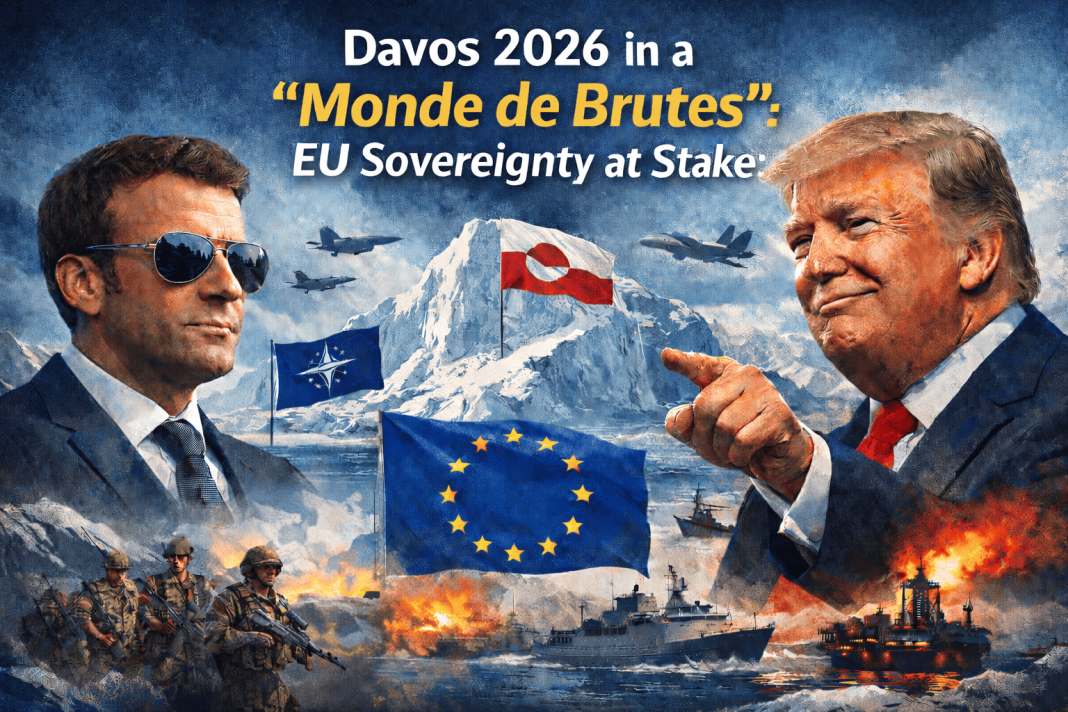

Davos is frequently portrayed as neutral ground, a venue where political leaders and corporate actors seek to rebuild trust and negotiate solutions. In 2026, the meeting adopted the rhetoric of “dialogue,” yet the most prominent signals indicated a shift toward status contests, coercive bargaining, and the capacity of the most powerful participants to set the agenda and compel others to respond.
Bertrand Badie provides a valuable framework for interpreting this period. In an “intersocial” world, where markets, media, and public opinion influence diplomacy, power operates through recognition as well as force. “Humiliation” is not merely a private emotion; it functions as a technique of hierarchy by denying equality, diminishing the other’s status, and restricting the range of credible actions available to weaker actors. The term “Monde de Brutes” encapsulates this environment, as reciprocity diminishes and pressure emerges as a primary diplomatic tool.
A widely circulated incident at Davos 2026 exemplifies this dynamic. Emmanuel Macron’s aviator sunglasses, worn due to an eye condition, became a global meme, and Donald Trump publicly mocked the appearance during his own address. While seemingly trivial in isolation, the episode is politically significant: ridicule diverts attention from substantive issues, positions the target as defensive, and transforms disagreement into a display of weakness. In an era of real-time political mediation, humiliation can spread more rapidly than policy.
Substantive issues were nonetheless present. Macron used the Davos platform to caution against a world in which the “law of the strongest” supplants predictable rules. He criticized tariff threats against European goods, characterizing them as unacceptable pressure, and French officials subsequently rejected assertions that Washington could dictate French policy through tariff intimidation. The central issue is not alignment with either Macron or Trump, but rather the use of tariffs as leverage to influence political behavior, extending beyond their role as economic policy.
The case of Greenland makes the issue of hierarchy explicit. Trump revived the proposal to acquire Greenland and advocated for a “framework” purported to grant the United States “total access” to the territory. Denmark and Greenland have consistently rejected the notion that sovereignty can be treated as a tradable asset. NATO Secretary-General Mark Rutte sought to reframe the situation as an Arctic security matter, urging allies to increase engagement in the region while maintaining that Greenland’s political status was not subject to negotiation. Although the framework remains ambiguous, the episode demonstrates how sovereignty can be readily reframed as a component of another actor’s security agenda.
The situation in Venezuela introduces a more consequential dimension, transforming rhetoric into precedent. Reuters reported in January 2026 that the United States conducted strikes and a special operation resulting in the capture of Venezuelan President Nicolás Maduro, who was subsequently brought to the United States to face criminal charges. Trump characterized the action as necessary for the political transition and did not exclude the possibility of further strikes. Regardless of perspectives on Maduro’s governance, the systemic implication is clear: exceptional measures can become normalized instruments of international management.
When tariff pressure, discussions of “total access” to Greenland, and interventionist precedents are considered together, Davos appears less as a forum for dialogue and more as a marketplace of coercion. For the European Union, this issue is central to the concept of sovereignty. EU sovereignty is frequently defined in institutional terms, such as single market strength, regulatory authority, and strategic autonomy. However, it also encompasses practical and symbolic aspects: the capacity to refuse without reprisal, to negotiate without ridicule, and to defend territory without external negotiation over the boundaries of sovereignty.
This issue also pertains to NATO. Alliances can withstand internal disagreements, but they face challenges when the most powerful member treats commitments as transactional and employs unrelated leverage as standard bargaining tools. The Greenland episode conveys a dual message: Europe is encouraged to increase security investments, yet priorities and pace are predominantly determined in Washington. Within a rules-based alliance, burden-sharing debates are constrained by shared principles. In a “Monde de Brutes,” however, such debates risk devolving into conditionality, where compliance is demanded or costs are imposed.
France’s doctrine of sovereignty offers one possible European response. Paris has consistently advocated for strategic autonomy, defined as the capacity to make independent decisions, withstand external pressure, and act with credibility. French strategic thought increasingly regards economic and technological coercion as security concerns and upholds deterrence as the ultimate assurance of independence. In this context, Macron’s call for a more capable and assertive Europe represents an effort to create strategic flexibility amid intensifying pressure politics.
The path forward is not a binary choice between “dialogue” and “strength,” but rather a synthesis of both. Europe requires capabilities that substantiate sovereignty, including defense industrial capacity, energy resilience, secure critical supply chains, and robust strategic infrastructure. Additionally, coalition discipline within NATO and the EU is essential to prevent external pressure on one member from undermining collective unity. Normative consistency is also necessary: if Europe aspires to dialogue among equals, it must resist the normalization of humiliation and coercion within its alliances and external relations.
For policymakers in Indonesia and other middle powers, the implications are pragmatic. In a “Monde de Brutes,” dignity constitutes a strategic resource rather than a luxury. Reducing vulnerability requires diversifying partnerships, reinforcing regional frameworks, and upholding rules that prevent “dialogue” from devolving into domination. The events of Davos 2026 underscore that dialogue is effective only when sovereign equality is regarded as a foundational principle, not as a concession.

